August 19 2026 at 08:00AM
🌱 HomeHarvest: Applying Project Management Principles to the Future of Homegrown Food
📌 Introduction: The Why
What if the backyard became more than an outdoor space?
What if it became a small, intelligent food system—one capable of helping a family grow vegetables, herbs, and other produce while reducing waste, improving sustainability, and creating a healthier relationship with the food they consume?
That is the vision behind HomeHarvest.
HomeHarvest is designed as a technology-enabled gardening ecosystem that brings together smart monitoring, personalized guidance, seasonal planning, sustainable products, and community into one homeowner experience.
The opportunity isn't simply to sell gardening products.
It's to help people manage the entire lifecycle of growing food at home.
🎯 The Problem: Gardening Has Become a Project Without a Project Manager
Starting a garden sounds simple.
Plant something.
Water it.
Give it sunlight.
Harvest it.
But anyone who has attempted to maintain a productive garden knows there are dozens of variables involved:
🌱 What should I plant?
💧 How much water does it need?
☀️ Is it receiving enough sunlight?
🌡️ Is the temperature appropriate?
🪴 Is the soil healthy?
🐛 Is something damaging the plant?
📅 When should I fertilize?
🥕 When should I harvest?
The homeowner is effectively managing a small agricultural project without a centralized system for planning, monitoring, and controlling it.
HomeHarvest changes that.
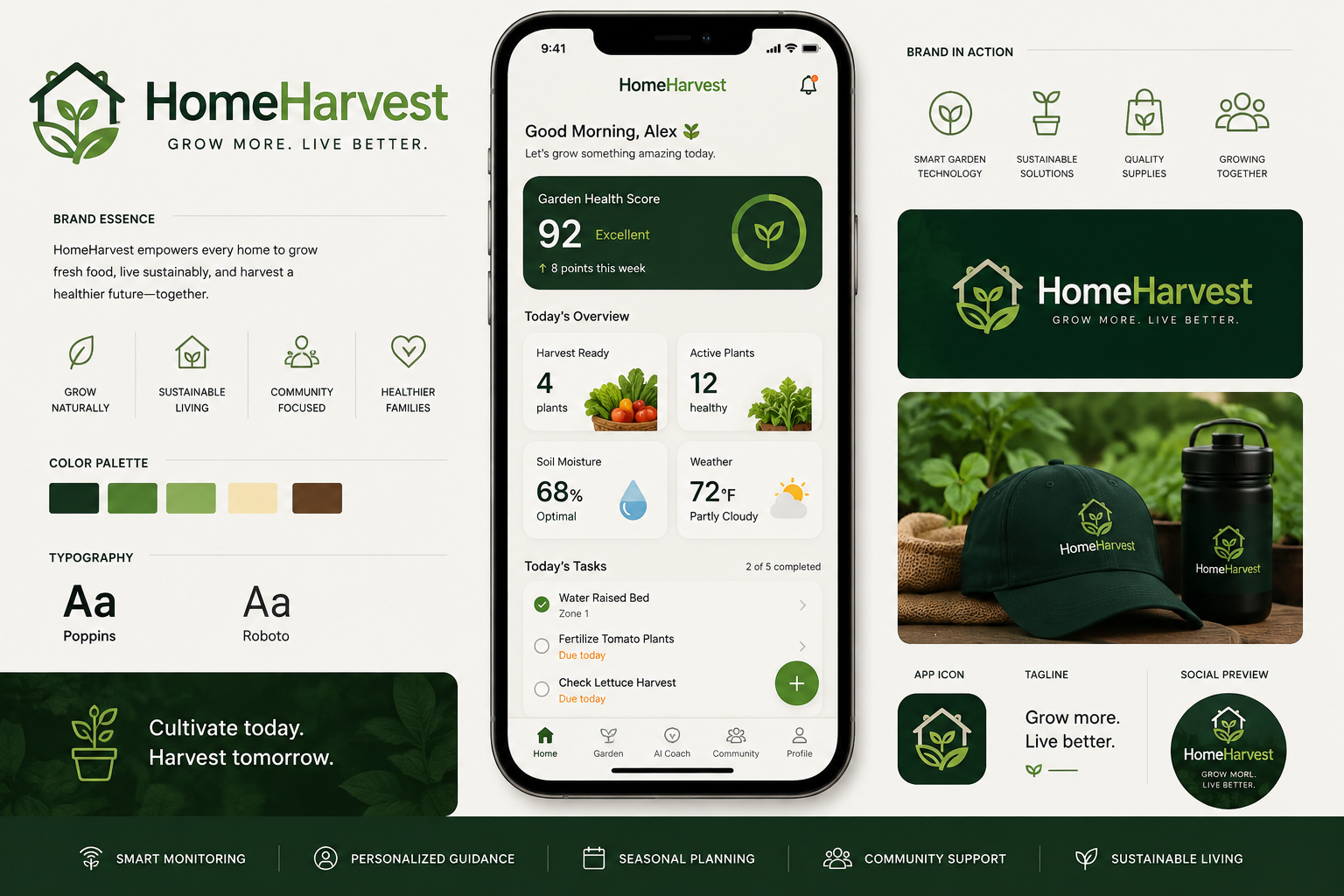
🤖 Introducing the HomeHarvest Ecosystem
HomeHarvest can function as a digital command center for the home garden.
The homeowner could open the application and immediately see:
Garden Health Score
Soil Moisture
Sunlight
Temperature
Upcoming Watering
Plants Ready to Harvest
Today's Tasks
AI Garden Recommendations
Instead of requiring homeowners to become gardening experts, HomeHarvest uses technology to help them make better decisions.
The goal is simple:
Grow more. Live better.
📊 Applying Project Management to the Garden
A garden may not look like a traditional project, but the principles of project management apply surprisingly well.
Scope Management
What are you trying to grow?
HomeHarvest can help homeowners define their garden's scope based on:
- Available space
- Climate
- Season
- Desired crops
- Available time
- Household consumption
The result is a garden designed around the homeowner—not the other way around.
Schedule Management
Every garden has a schedule.
Seeds need to be planted.
Plants need to be watered.
Soil needs attention.
Crops need to be harvested.
HomeHarvest can convert these activities into an intelligent maintenance schedule.
Instead of remembering everything, homeowners receive the right task at the right time.
Risk Management
Every garden has risks.
🌧️ Too much rain.
☀️ Too much heat.
💧 Too little water.
🐛 Pests.
🌱 Nutrient deficiencies.
HomeHarvest can use monitoring data and AI recommendations to identify potential issues earlier.
This shifts gardening from reactive problem solving to proactive risk management.
💰 The Hidden ROI of a Home Garden
One of the most interesting opportunities is turning the garden into a measurable household asset.
Imagine HomeHarvest tracking:
Produce harvested: $487
Estimated grocery savings: $312
Food waste avoided: $96
Water used: 8,400 gallons
Organic material recycled: 180 lbs
Over time, the homeowner develops a digital record of the economic and environmental value their garden creates.
This transforms gardening from a hobby into a measurable household sustainability initiative.
🧠 AI as the Home Garden Advisor
One of HomeHarvest's most powerful capabilities could be its AI Garden Coach.
Instead of searching the internet every time something looks wrong, homeowners could ask:
"Why are my tomato leaves turning yellow?"
"Should I water my garden today?"
"What should I plant next month?"
"When should I harvest these peppers?"
The AI could combine the homeowner's garden profile, environmental conditions, plant history, and seasonal information to provide personalized recommendations.
The objective isn't simply to provide information.
It's to turn information into action.
🌎 Sustainability Begins at Home
HomeHarvest also represents a broader sustainability opportunity.
A household garden can contribute to:
🌱 Local food production
♻️ Composting
💧 More conscious water usage
🥕 Reduced food waste
🌿 Biodiversity
🏡 Greater household resilience
The individual impact of one garden may seem small.
But thousands—or millions—of connected home gardens create something much larger: a distributed network of small-scale food production.
🤝 From Individual Gardens to a Community
The platform could eventually connect homeowners through a HomeHarvest community.
Imagine neighbors being able to:
- Share excess produce
- Exchange seeds
- Recommend local growers
- Participate in challenges
- Compare sustainability achievements
- Learn from experienced gardeners
This creates a network effect.
The homeowner isn't simply managing a garden anymore.
They're participating in a community of growers.
📈 Building a Recurring-Value Business
The strongest opportunity may be the recurring relationship HomeHarvest can create with the homeowner.
The initial garden setup could lead to:
- Smart sensors
- Seeds
- Soil products
- Fertilizer
- Replacement supplies
- Seasonal planting kits
- AI subscriptions
- Garden maintenance
- Educational content
- Marketplace purchases
This creates a lifecycle business rather than a one-time gardening transaction.
The homeowner's garden changes every season.
The HomeHarvest relationship changes with it.
🏁 Final Thoughts
Project management is ultimately about turning a vision into a measurable outcome.
HomeHarvest applies that philosophy to something remarkably personal: what we grow and eat at home.
The future of gardening may not simply be a smarter planter or a better gardening tool.
It could be an intelligent ecosystem that understands the garden, anticipates its needs, guides the homeowner, measures its impact, and continuously helps improve the outcome.
The homeowner becomes the project sponsor.
The garden becomes the portfolio.
The plants become the deliverables.
The seasons become the project lifecycle.
And AI becomes the advisor helping bring everything together.
Perhaps the next generation of smart homes won't just be homes that consume store bought resources mostly.
They'll be homes that produce 90% of their own goods, while reducing waste too. 🌱