October 20 2026 at 03:37PM
AI Governance Is the Missing Link in Customer Service AI Adoption
A Know Your Customer Day Special for AI Leaders
Did you know? A customer-service AI assistant can answer thousands of questions in seconds, operate around the clock, and reduce routine workloads—but a single incorrect answer about a refund, payment, eligibility requirement, or customer entitlement can undermine the trust an organization has spent years building.
As organizations embrace generative AI, conversational assistants, and autonomous AI agents, one leadership question deserves greater attention: Are we making customer service faster, or are we making it more trustworthy?
In the spirit of Know Your Customer Day, this is an opportunity to look beyond customer profiles and transaction histories and consider what it truly means to understand, protect, and serve customers in an AI-enabled world.
The missing link is not necessarily a more powerful model. It is AI governance that connects customer understanding, business accountability, responsible data use, and measurable service outcomes.
- From Knowing the Customer to Respecting the Customer
Traditional customer-service systems have helped organizations understand purchasing patterns, service histories, preferences, and support needs. AI can build on this foundation by summarizing customer interactions, suggesting relevant responses, identifying recurring problems, and helping service teams resolve issues more efficiently.
But knowing more about a customer does not automatically mean serving that customer better.
Consider a customer who contacts a financial services company about a disputed payment. An AI assistant may have access to transaction details, prior complaints, and account information. It might generate a response quickly, but what if it reveals sensitive information to the wrong person, incorrectly labels the customer as high-risk, or recommends an action based on incomplete records?
The problem is not simply technical accuracy. It involves identity verification, data minimization, fairness, access control, and accountability.
Responsible customer-service AI should therefore answer five questions:
- Purpose: Why does the AI need this customer information?
- Permission: Is the information being accessed and used appropriately?
- Accuracy: Is the response grounded in current, authoritative business information?
- Fairness: Could the system disadvantage certain customers or misunderstand their circumstances?
- Accountability: Who is responsible when the AI provides a misleading answer or takes an inappropriate action?
These questions turn customer knowledge into responsible customer service.
- A Real-World Lesson: When a Chatbot Gets the Answer Wrong
Consider the widely discussed Air Canada chatbot case.
In Moffatt v. Air Canada (2024), a customer sought information about bereavement fares after the death of a family member. The airline’s website chatbot incorrectly suggested that a reduced fare could be requested retroactively. The customer relied on that information, but the airline subsequently refused the request under its actual policy.
On February 14, 2024, the British Columbia Civil Resolution Tribunal found Air Canada responsible for the misleading information and awarded compensation. The case demonstrated that an organization cannot simply treat a customer-facing chatbot as separate from its service obligations.
Source: CityNews, reporting on the Air Canada chatbot decision.
The leadership lesson: An AI assistant represents the organization in the customer’s eyes. If it communicates an incorrect policy, the customer experiences that as an organizational failure—not merely a model error.
For project managers, this case highlights the importance of requirements traceability, authoritative knowledge sources, scenario-based testing, escalation paths, and clear ownership of customer-facing AI outputs.
Imagine applying these controls before deployment:
- The chatbot retrieves answers from approved, current policy documents.
- High-impact answers include links to the relevant policy or source.
- Conflicting or missing information triggers a safe response instead of a confident guess.
- Customers can reach a human representative without unnecessary friction.
- Policy changes trigger knowledge-base updates and regression testing.
These controls will not eliminate every error. They can, however, make errors easier to detect, contain, correct, and learn from.
- Why AI Governance Must Be Part of the Customer Journey
AI governance is sometimes treated as a compliance exercise that happens after a product has been built. In customer service, that approach can be costly.
Governance should be embedded across the customer journey—from identity verification and data collection to AI-generated responses, automated actions, complaints, and resolution.
Privacy by design: Customer information should be limited to what is necessary for the specific service task. Sensitive data should not be exposed in prompts, logs, or responses without appropriate safeguards.
Transparency: Customers should understand when they are interacting with AI where that information is relevant. The organization should not imply that an AI-generated answer is a verified human decision.
Human oversight: Complaints, ambiguous requests, vulnerable-customer situations, disputed transactions, and consequential decisions should have appropriate routes to qualified human review.
Fairness and accessibility: Systems should be evaluated across languages, accents, communication styles, disabilities, and customer groups. A service assistant that performs well for one group may perform poorly for another.
Security and resilience: Organizations need controls against prompt injection, unauthorized access, data leakage, and attempts to manipulate AI agents into taking actions outside their permitted scope.
Accountability: Every deployed system should have an owner, defined boundaries, incident procedures, and a process for reviewing and correcting harmful or misleading outcomes.
These principles align with the National Institute of Standards and Technology’s AI Risk Management Framework, which organizes AI risk management around four functions: Govern, Map, Measure, and Manage. The framework emphasizes continuous risk management throughout the AI lifecycle.
Reference: NIST AI Risk Management Framework Core.
- From Chatbots to AI Agents: The Stakes Are Changing
The next generation of customer-service AI will do more than answer questions. AI agents may retrieve account information, update customer records, initiate service requests, schedule appointments, process eligible refunds, or coordinate multiple systems.
That creates new opportunities—and new risks.
Consider an illustrative retail scenario. A customer contacts an AI assistant about a delayed order. A conversational chatbot might explain the delivery status. An AI agent connected to order management could go further by checking inventory, identifying an alternative delivery date, and initiating a replacement shipment.
The business value is clear: fewer handoffs, faster resolution, and less repetitive work for employees.
However, if the agent changes an address without proper verification, issues a refund outside its authority, or acts on a malicious instruction embedded in an untrusted message, automation can amplify the impact of a mistake.
The answer is not to prohibit useful automation. It is to match the level of autonomy to the level of risk.
A practical operating model is:
- Recommend: AI proposes a response or action; a human decides.
- Prepare: AI gathers information and prepares an action for approval.
- Execute within limits: AI performs predefined, low-risk actions under explicit permissions and monitoring.
- Escalate: AI pauses when identity, policy, uncertainty, customer impact, or authorization crosses a defined threshold.
For example, an agent might automatically provide an order-status update, prepare a refund request for review, and require explicit authorization before making a high-value financial adjustment.
The principle is simple: the greater the potential customer impact, the stronger the required controls and oversight.
- The Project Manager’s Role: Turn Governance into Delivery
Responsible AI governance cannot sit exclusively with legal, compliance, cybersecurity, or data science teams. It must be translated into delivery requirements, operating procedures, and measurable acceptance criteria.
Project managers can help bridge that gap through six practical actions.
- Define customer-centered success measures.
Do not measure success only by chatbot adoption, response speed, or cost reduction. Include first-contact resolution, customer satisfaction, repeat-contact rates, escalation quality, complaint rates, accessibility, and the accuracy of policy-related answers.
- Build a customer-service AI risk register.
Identify risks such as incorrect answers, privacy exposure, biased service, unauthorized actions, outdated knowledge, poor escalation, and vendor dependency. Assign an owner, mitigation, and monitoring method to each material risk.
- Establish a trusted knowledge source.
Define which policy documents, product records, FAQs, and service procedures the AI may use. Establish content ownership, version control, update frequency, and a way to detect conflicting or outdated information.
- Test real customer scenarios—not just happy paths.
Test ambiguous questions, emotional complaints, conflicting policies, unusual requests, multilingual interactions, identity-verification failures, prompt injection, and attempts to obtain another customer’s information. Include edge cases before release and after significant updates.
- Define clear decision rights.
Specify what the AI may answer, recommend, prepare, or execute; what requires approval; and when a human must take over. Make sure the service team knows how to intervene and how to report incidents.
- Monitor performance after launch.
Review a risk-based sample of conversations, track recurring errors, gather customer and employee feedback, and reassess performance after changes to models, prompts, policies, or integrations. Define thresholds for remediation, rollback, or suspension.
These controls should be built into the project plan, backlog, acceptance criteria, release gates, operational handover, and continuous-improvement cycle.
- A 30-Day Roadmap for Responsible Customer-Service AI
Leadership teams do not need to solve every governance challenge before beginning. They do need a disciplined starting point.
Week 1 — Understand the customer and the risk
Select one service workflow. Map customer needs, data flows, pain points, affected groups, and potential harms. Identify where AI adds value and where human judgment remains essential.
Week 2 — Define the guardrails
Assign business and technical owners. Approve authoritative knowledge sources, access controls, escalation rules, permitted actions, and evaluation criteria. Agree on how customers will be informed about AI involvement.
Week 3 — Test before release
Run representative scenarios with service agents, QA, security, privacy, and business stakeholders. Test factual accuracy, policy consistency, privacy, fairness, accessibility, and safe handling of uncertainty. Record defects and require resolution of critical issues.
Week 4 — Pilot, measure, and learn
Launch with a limited scope and appropriate monitoring. Compare service quality and customer outcomes with the existing process. Review errors and escalations, collect feedback, and decide whether to expand, revise, or pause the pilot.
The 30-day period is a practical pilot structure, not a guarantee that every AI use case will be ready for production in one month. Higher-risk applications may require substantially more assessment and validation.
- What Leadership Should Measure
A responsible AI program should demonstrate both business value and customer protection.
Establish baselines before the pilot and review trade-offs rather than optimizing a single metric. Faster responses are not a success if they produce more repeat contacts, inaccurate commitments, or preventable customer harm.
- The Future of Customer Service Is Human-Centered AI
Know Your Customer Day is a useful reminder that customer understanding should lead to better service—not unrestricted data collection or automated decisions without accountability.
AI can help organizations understand customer needs, respond consistently, reduce repetitive work, and make services more accessible. But these benefits depend on the quality of the knowledge behind the system, the safeguards around its behavior, and the people accountable for its outcomes.
For AI leaders, the strategic opportunity is to move from AI adoption to responsible AI-enabled service transformation.
For project managers, the opportunity is to make governance actionable: define controls, test real-world scenarios, measure customer outcomes, and ensure that accountability survives the transition from pilot to production.
For customer-service leaders, the challenge is to build a service experience in which automation makes help easier to access without making the organization harder to reach when it matters most.
A Leadership Call to Action
Before your next customer-service AI deployment, ask three questions:
- Can we explain and verify what our AI tells customers?
- Can we prevent, detect, and correct harmful or unauthorized actions?
- Can customers reach an accountable human when AI is uncertain or gets it wrong?
If the answer to any of these questions is unclear, the next step may not be a bigger model or a faster rollout. It may be stronger governance.
The future of customer service will not be defined by how much AI can automate. It will be defined by how responsibly organizations use AI to earn, protect, and sustain customer trust.
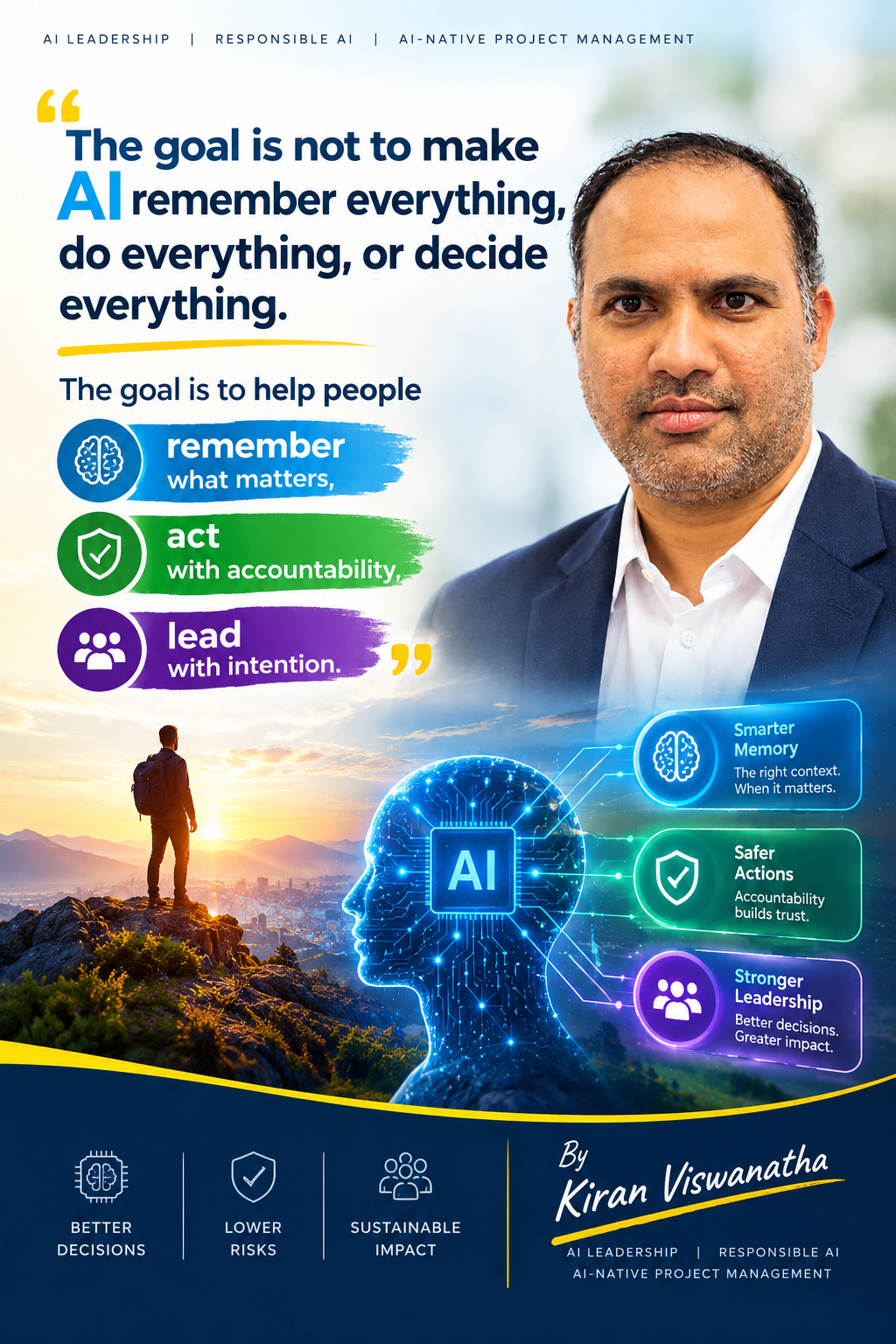
“The goal is not just to automate customer service. It is to make every AI-enabled interaction more accurate, accountable, and worthy of customer trust.”
— Kiran Viswanatha