July 31 2026 at 09:26AM
AI Journey Map for Neurodivergent People: Designing an Inclusive Future from Awareness to Empowerment
AI has the potential to become one of the most impactful assistive technologies of our generation—not by replacing human support, but by adapting to each person's unique way of learning, communicating, and interacting with the world.
For millions of neurodivergent individuals, including people with Autism Spectrum Disorder (ASD) and Intellectual and Developmental Disabilities (IDD), AI can help reduce barriers, increase independence, and unlock opportunities in education, employment, healthcare, and daily living.
For startup founders and AI leaders, this represents both a profound social responsibility and an opportunity to build products that serve an often-overlooked community.
Why an AI Journey Map Matters
Every AI product follows a user journey, but neurodivergent users often experience technology differently. A thoughtfully designed AI journey map helps teams understand where support, accessibility, and trust are most needed.
Rather than asking, "How can AI automate?" the better question is:
"How can AI adapt to the individual?"
This shift from technology-first to human-centered design is at the heart of Responsible AI.
The AI Journey Map
Stage 1: Awareness – Discovering AI
For many families, educators, and caregivers, the first challenge is understanding what AI can realistically do.
Examples include:
- AI-powered communication tools
- Speech-to-text and text-to-speech assistants
- Visual schedules and routine planners
- Emotion recognition support
- Personalized learning platforms
Leadership Insight: Accessibility begins with awareness. Clear communication about AI capabilities and limitations builds trust.
Stage 2: Onboarding – Making AI Easy to Use
Technology should adapt to the person—not the other way around.
Inclusive onboarding might include:
- Simple interfaces
- Voice guidance
- Visual instructions
- Step-by-step interactions
- Adjustable sensory settings
For individuals with ASD or IDD, reducing cognitive load can make the difference between adoption and abandonment.
Project Management Tip: Include neurodivergent users, caregivers, and educators in usability testing from the earliest design stages.
Stage 3: Personalized Support
One-size-fits-all AI rarely works.
Responsible AI should learn user preferences while respecting privacy and consent.
Examples:
- Personalized learning pace
- Visual versus verbal prompts
- Predictable routines
- Adaptive reminders
- Individual communication styles
The goal is personalization without stereotyping.
Stage 4: Daily Independence
This is where AI creates meaningful impact.
Examples include:
- Planning daily routines
- Medication reminders
- Navigating public transportation
- Budgeting assistance
- Workplace coaching
- Social communication support
For many users, AI becomes a trusted assistant that complements—not replaces—family members, caregivers, educators, and support professionals.
Stage 5: Lifelong Growth
The journey does not end with adoption.
AI can support transitions through school, employment, independent living, and lifelong learning.
Imagine an AI companion that evolves alongside the user, adapting to changing goals while maintaining appropriate safeguards and transparency.
Why Startup Founders Should Pay Attention
The accessibility market is substantial and growing, yet many AI products still overlook neurodivergent users.
Founders who embrace inclusive design from the outset can:
- Expand their addressable market
- Build stronger user trust
- Differentiate through accessibility
- Reduce costly redesigns later
- Align with emerging Responsible AI expectations
Inclusive design is not simply a compliance exercise—it is a driver of innovation.
Real-World Examples
Several AI-enabled solutions already demonstrate this potential:
- AI-powered augmentative and alternative communication (AAC) tools help individuals express themselves more effectively.
- AI-assisted reading and writing applications provide personalized support for learning differences.
- Predictive scheduling tools help users manage routines and transitions, reducing anxiety.
- AI-driven coaching platforms assist neurodivergent employees with workplace organization and communication.
These examples illustrate that AI is most effective when it augments human support rather than attempting to replace it.
Governance Considerations
As AI becomes more integrated into assistive technologies, governance must address critical questions:
- How is consent obtained and respected?
- Is personal data collected only when necessary?
- Can users or caregivers understand how recommendations are generated?
- Are AI systems tested with diverse neurodivergent populations?
- Is there always an option for human support when needed?
Responsible AI is not only about preventing harm; it is about ensuring equitable access and preserving user dignity.
What This Means for Project Managers
Project managers play a pivotal role in embedding inclusion throughout the AI lifecycle by:
- Engaging neurodivergent users and caregivers early in design.
- Defining accessibility requirements as core project deliverables.
- Including fairness, usability, and trust metrics alongside technical KPIs.
- Collaborating across engineering, design, clinical, legal, and accessibility teams.
- Planning for continuous feedback and iterative improvement after deployment.
Inclusive AI is achieved through intentional collaboration, not by accident.
A Leadership Perspective
The future of AI will not be measured solely by how intelligent systems become, but by who benefits from that intelligence.
When AI is designed with neurodivergent individuals in mind, it often becomes more intuitive, flexible, and trustworthy for everyone. This is the essence of universal design: solutions created for inclusion frequently improve the experience for all users.
Final Thoughts
The AI journey for neurodivergent people is not simply a roadmap for technology adoption—it is a roadmap toward greater independence, opportunity, and participation.
For startup founders, it is an invitation to innovate with empathy.
For project managers, it is a call to integrate accessibility into every phase of delivery.
For AI leaders, it is a reminder that governance, ethics, and inclusion are not barriers to innovation—they are the foundation of sustainable innovation.
As we shape the future of AI, our success should be measured not only by the sophistication of our algorithms but by our ability to create systems that empower every individual to thrive.
Because the most impactful AI is not the one that serves the most people—it is the one that ensures no one is left behind.
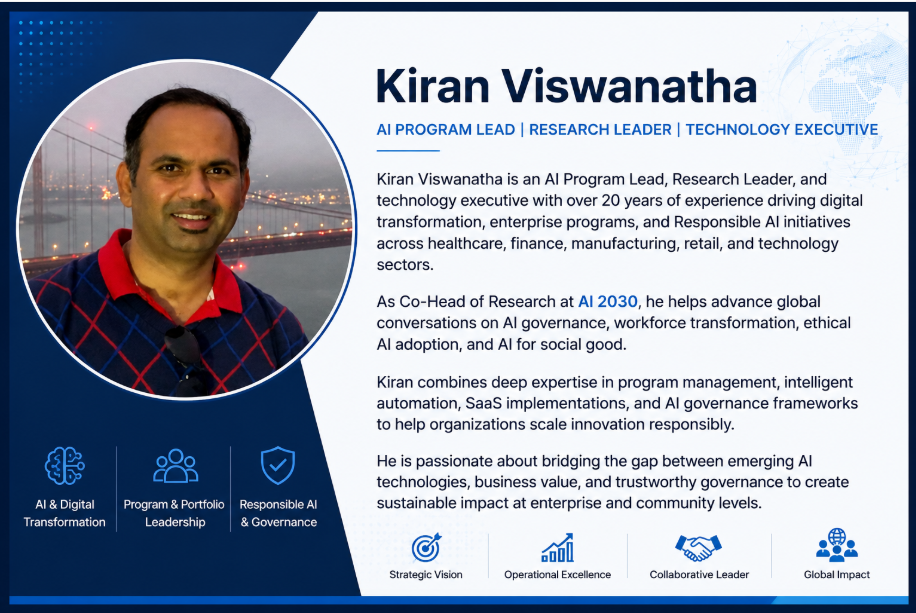
By Kiran Viswanatha
AI Program Leader | Co-Head of Research | Responsible AI Advocate