August 24 2026 at 09:57AM
American Materials Exchange: Using Project Management to Build a Stronger U.S. Industrial Base
📌 Introduction - The Why
What if one of America's biggest competitive advantages isn't a single factory, mine, or technology—but our ability to connect thousands of American suppliers into one intelligent network?
Aerospace.
Defense.
Semiconductors.
Energy.
Medical devices.
Advanced manufacturing.
All of these industries depend on materials and components that must be available when they are needed, where they are needed, and at the quality required.
The challenge isn't simply producing more.
It's knowing who can produce what, where they are located, what capacity they have, whether they are qualified, and how quickly they can scale.
This is where project management can play a critical role.
The Supply Chain Is a Portfolio
Project managers understand something that is often overlooked in supply-chain strategy:
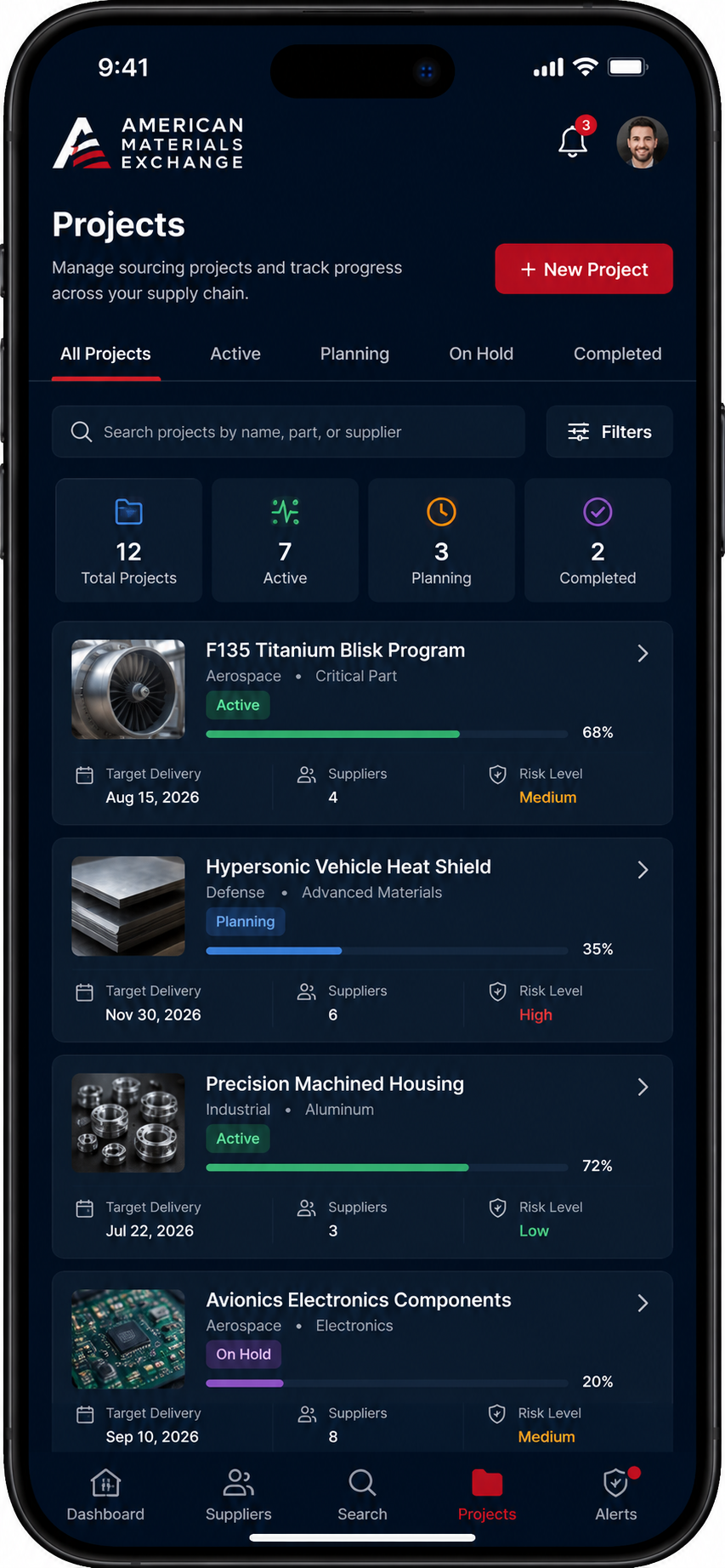
Every supplier represents a potential project risk.
A critical component might depend on:
- One manufacturer
- One geographic region
- One raw material
- One specialized machine
- One overseas source
- One qualified workforce
If any of those dependencies fail, an entire program can be affected.
That means supply chains should be managed more like portfolios of interconnected projects and risks rather than simple lists of vendors.
🏭 Introducing American Materials Exchange
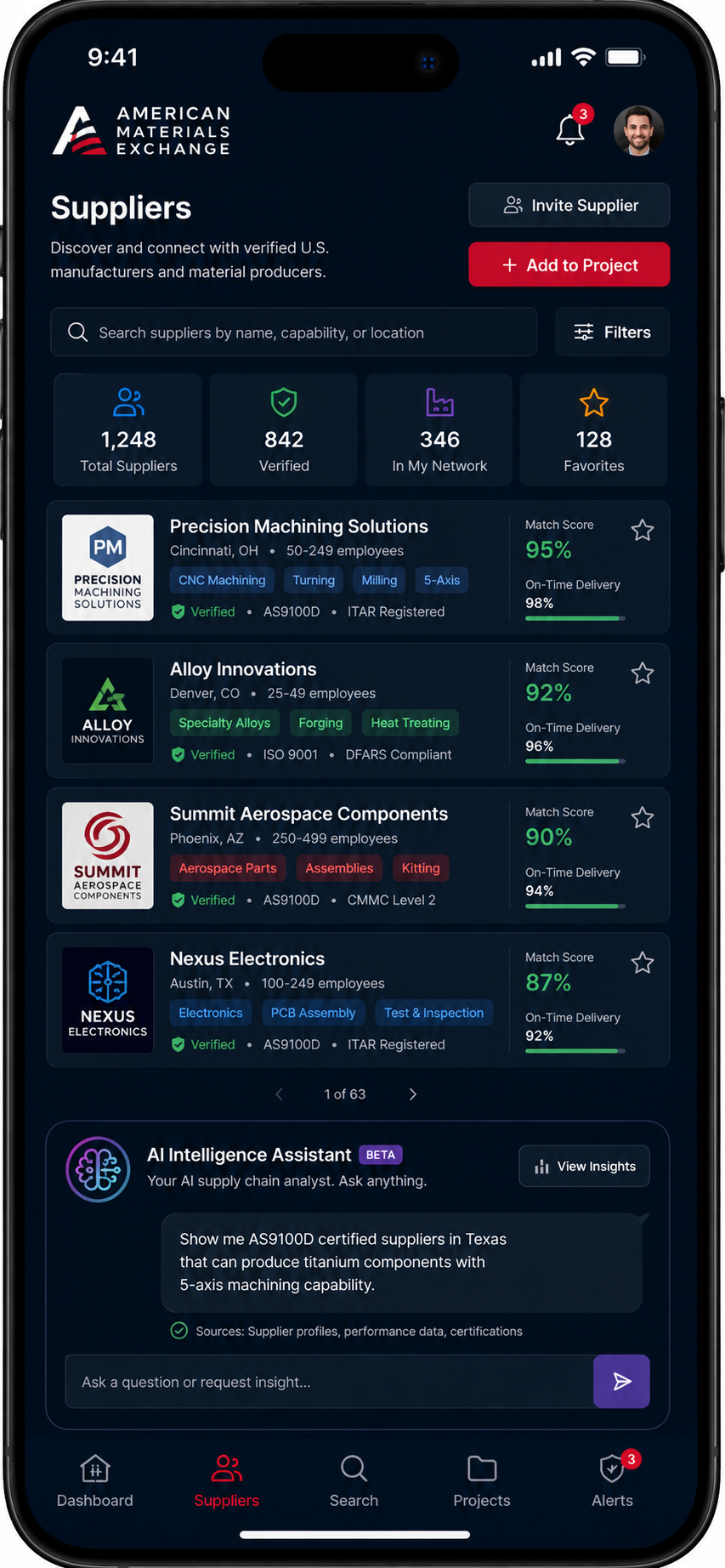
Imagine a B2B platform where qualified American manufacturers can showcase their capabilities to aerospace, defense, energy, medical-device, and advanced-manufacturing buyers.
Each supplier could maintain a verified digital profile containing:
Capabilities
What can the company manufacture?
Capacity
How much can it produce?
Location
Where is production occurring?
Certifications
What quality and industry certifications does it maintain?
Lead Time
How quickly can it deliver?
Materials
What materials and components can it produce?
Scalability
How quickly can production increase?
The result would be more than a marketplace.
It would become a digital map of American industrial capability.
📊 Turning Supplier Data Into Project Intelligence
Project managers routinely ask:
What resources do we need?
When do we need them?
Who is responsible?
What could go wrong?
What is our contingency plan?
Those same questions can be applied to industrial supply chains.
Imagine an aerospace program requiring a specialized aluminum component.
Instead of beginning with a traditional supplier search, the project team could enter its requirements into American Materials Exchange.
The platform could identify:
Primary Supplier
Current capacity: 80%
Lead time: 14 weeks
Location: Ohio
Alternative Supplier
Current capacity: 55%
Lead time: 10 weeks
Location: Texas
Emerging Supplier
Current capacity: 30%
Expansion capability: High
Location: Arizona
Suddenly, procurement becomes a portfolio-management exercise.
🔎 Risk Management at the Supplier Level
One of the most important responsibilities of a project manager is identifying risk before it becomes an issue.
The same principle applies here.
An AI-enabled platform could calculate a supplier risk score based on:
🌎 Geographic concentration
🏭 Production capacity
📦 Lead times
🧱 Material availability
👥 Workforce capacity
💰 Financial stability
🔗 Single-source dependency
📋 Qualification status
The objective isn't to eliminate risk.
It is to make risk visible.
Once risk becomes visible, project teams can create mitigation strategies.
🔄 Building the Second Source
One of the most powerful capabilities could be identifying alternative suppliers before a crisis occurs.
Consider a company that depends on one manufacturer for a critical component.
The platform could identify three qualified American companies capable of producing a similar component.
The project manager could then create a sourcing strategy:
Primary Supplier → Secondary Supplier → Contingency Supplier
That is classic project risk management applied to the industrial base.
Why This Matters Now
The United States is actively investing in domestic manufacturing and supply-chain resilience.
In August 2026, the U.S. Small Business Administration announced a $20 million Critical Suppliers Prize Competition designed to expand production capacity at critical supply-chain chokepoints. The priority areas include advanced metals, advanced materials, and energy systems.
The SBA has also been building supplier matchmaking programs connecting small domestic manufacturers with large industrial buyers. In 2026, these events have included companies and organizations across aerospace, semiconductor, automotive, and government markets.
Meanwhile, the Department of Defense's FY2026 budget specifically identifies critical materials, domestic processing, recycling, supply-chain visibility, and alternative sources as areas requiring continued investment.
The message is clear:
Domestic industrial capacity is becoming a strategic asset.
📈 From Marketplace to Industrial Intelligence
The long-term opportunity is bigger than matching buyers and sellers.
Imagine collecting enough verified data to understand:
- Where America's manufacturing capacity exists
- Which materials are becoming constrained
- Which suppliers are approaching capacity
- Where new factories are emerging
- Which regions have workforce shortages
- Which components have single-source dependencies
- Where additional investment could create the greatest capacity
The platform could eventually become an industrial intelligence system.
Instead of simply asking:
"Who can manufacture this?"
A company could ask:
"Where is the safest place in America to build this supply chain?"
That's a much more valuable question.
🎯 The PMP Connection
This concept demonstrates how project management is evolving.
The traditional project manager manages:
Scope → Schedule → Cost → Quality → Risk
The modern project manager increasingly has to understand:
Supply Chain → Data → Resilience → Stakeholders → Strategic Risk
American Materials Exchange sits directly at that intersection.
A successful platform could give project managers visibility into the resources required to execute their programs before those resources become constraints.
🚀 The Long-Term Vision
Imagine an American manufacturing ecosystem where a project manager can enter:
Product: Advanced aerospace component
Required material: Specialty alloy
Annual volume: 100,000 units
Required certifications: XYZ
Delivery requirement: 30 days
The platform responds with:
U.S. Supply Network
14 qualified suppliers
6 states
3 immediate production options
4 potential secondary suppliers
2 suppliers capable of expansion
1 high-risk material dependency
Now the project manager isn't simply managing a procurement process.
They're managing the resilience of the project itself.
🏁 Final Thoughts
America's industrial future will not be built by one company.
It will be built by thousands of manufacturers, suppliers, engineers, workers, entrepreneurs, investors, and project professionals working together.
The challenge is connecting those capabilities.
Project managers are uniquely positioned to help make that connection.
We already manage complexity.
We already manage stakeholders.
We already manage risk.
We already manage resources.
The next evolution is applying those capabilities to the industrial ecosystem itself.
American Materials Exchange represents one possible vision:
A digital marketplace for American manufacturing.
A risk-management platform for supply chains.
And eventually, an intelligence layer for the U.S. industrial base.
Because resilient supply chains aren't created when the crisis begins.
They are designed before the crisis ever happens.
🇺🇸 Build the network. Manage the risk. Strengthen the supply chain.