October 13 2026 at 02:12PM
Charting the AI Voyage: How PMOs Can Steer Responsible Tech Deployment
A Columbus Day Special for Project Professionals
Did you know?
On October 12, 1492, Christopher Columbus's expedition reached an island in what is now the Bahamas after a voyage across the Atlantic. The journey is historically significant but also deeply complex, with profound consequences for Indigenous peoples and the Americas. Today, Columbus Day and Indigenous Peoples' Day are observed differently across communities.
For project professionals, however, the historical idea of navigation—setting a destination, reading the environment, managing uncertainty, and adapting to changing conditions—offers a useful metaphor for today's AI transformation journey.
Because deploying AI responsibly is not simply about having a powerful technology.
It is about knowing where you are going, understanding the risks along the way, and ensuring that everyone aboard the project knows who is responsible for the journey.
That is where the Project Management Office (PMO) can become the organization's AI navigation center.
🧭 The New AI Ocean
Organizations are moving rapidly from AI experimentation to enterprise deployment.
Generative AI is being incorporated into customer service, software development, knowledge management, analytics, marketing, HR, healthcare, finance, supply chains, and project delivery.
But the waters are not always calm.
AI initiatives can encounter:
- Unclear business objectives
- Rapidly changing technology
- Poor-quality or inaccessible data
- Privacy and cybersecurity concerns
- Hallucinations and unreliable outputs
- Bias and unintended impacts
- Regulatory obligations
- Intellectual-property questions
- Resistance from employees
- Vendor and model dependency
- Unclear accountability
- Difficulty measuring business value
For PMOs, this creates a critical question:
How can we help the organization move quickly without allowing AI innovation to move faster than responsible governance?
⚓ The PMO as the AI Navigator
Traditionally, PMOs have helped organizations standardize delivery, manage portfolios, coordinate resources, monitor risks, and align projects with strategy.
AI adds another dimension.
The PMO can become a strategic navigation layer between AI ambition and responsible execution.
Rather than asking only:
“Is the project on schedule and budget?”
the AI-enabled PMO should also ask:
“Are we delivering the right AI capability, with the right controls, for the right people, and with measurable value?”
This is consistent with PMI's 2026 Standard for Artificial Intelligence in Portfolio, Program and Project Management, which provides project professionals with a framework covering strategic value, risk, governance and compliance, people and culture, ethics, stakeholder engagement, optimization, data quality, and human-in-the-loop practices.
🗺️ First, Draw the Map: Define the AI Destination
Every voyage needs a destination.
Every AI project needs a clearly defined outcome.
A PMO should challenge vague objectives such as:
“Implement GenAI across the organization.”
Instead, ask:
What business problem are we solving?
For example:
Instead of:
Deploy an AI chatbot for employees.
Consider:
Reduce employee time spent searching approved organizational knowledge by 40%, while maintaining defined accuracy, privacy, security, escalation, and human-review controls.
The second objective provides:
A destination.
A measurable outcome.
A governance boundary.
A basis for investment decisions.
🌊 Manage the Scope Before the Scope Manages You
AI projects can experience an unusual form of scope expansion.
A team starts with:
“Let's build a knowledge assistant.”
Then comes:
“Can it summarize meetings?”
Then:
“Can it draft emails?”
Then:
“Can it access customer records?”
Then:
“Can it make recommendations?”
Then:
“Can it execute transactions?”
The project has quietly evolved from an AI assistant into an autonomous agent.
The PMO needs to establish clear boundaries.
Define:
In scope
- Approved AI use cases
- Authorized users
- Approved data
- Approved models
- Defined integrations
- Defined automation level
Out of scope
- Unauthorized sensitive data
- Unapproved autonomous decisions
- High-impact use cases without additional controls
- Unapproved external integrations
- Actions beyond defined permissions
This is not bureaucracy.
It is navigation.
A ship without boundaries does not become more innovative.
It simply becomes harder to control.
NIST's AI Risk Management Framework organizes AI risk management around four functions: Govern, Map, Measure, and Manage, with governance acting as a cross-cutting activity throughout the AI lifecycle.
For PMOs, this provides a useful mental model:
Govern the voyage.
Map the risks.
Measure the controls.
Manage what changes.
🛟 Human-in-the-Loop: Keep the Captain on the Bridge
One of the most important questions for any AI project is:
Where does human judgment remain mandatory?
AI can summarize information, identify patterns, generate recommendations, and accelerate decisions.
But AI should not automatically become the accountable decision-maker.
Consider:
Low impact:
AI summarizes a project meeting.
Moderate impact:
AI identifies potential schedule risks.
Higher impact:
AI recommends which employees should receive development opportunities.
Potentially high impact:
AI influences hiring, termination, credit, healthcare, or other consequential decisions.
The governance requirements should become stronger as the potential impact increases.
PMI's current AI standard explicitly emphasizes human-in-the-loop practices, including reviewing AI outputs and determining when recommendations should be accepted, escalated, or overridden.
A PMO should therefore define:
AI recommends → Human reviews → Human decides → Decision is accountable and traceable.
🔍 Measure More Than “AI Adoption”
One of the biggest PMO mistakes would be measuring AI success by the number of users or licenses.
AI adoption is not the same as AI value.
Instead, PMOs should track:
Business value
- Cost reduction
- Revenue impact
- Productivity
- Cycle-time improvement
Quality
- Accuracy
- Reliability
- Error rates
- User satisfaction
Risk
- AI incidents
- Privacy events
- Security findings
- Bias or fairness concerns
Governance
- Approved use cases
- Completed risk assessments
- Control effectiveness
- Audit findings
- Exception approvals
People
- AI literacy
- Training completion
- Employee adoption
- Stakeholder confidence
Sustainability
- Model efficiency
- Infrastructure impact
- Long-term operational cost
The question should move from:
“How much AI are we using?”
to:
“What measurable value are we creating—and what risks are we controlling?”
🏛️ Governance Should Not Be the Harbor at the End
A common mistake is to treat governance as a final checkpoint:
Build → Test → Deploy → Governance Review
By then, architectural decisions, data choices, vendor contracts, and user expectations may already be difficult to change.
A stronger approach is:
Govern → Plan → Design → Build → Test → Deploy → Monitor → Improve
Governance begins when the idea begins.
NIST describes AI risk management as continuous across the AI lifecycle, with testing, monitoring, documentation, and continual improvement rather than a one-time compliance exercise.
For PMOs, that means governance belongs inside the project lifecycle, not outside it.
📦 The AI Governance Cargo Manifest
Every AI project should have a clear record of what it is carrying.
A PMO can establish a standard AI Project Governance Pack containing:
- AI Use-Case Statement
What is the AI intended to do?
- Business Value Case
Why are we doing it?
- Data Assessment
What data does it use?
- Risk Assessment
What can go wrong?
- Human Oversight Model
Where must people review or approve?
- Security & Privacy Assessment
How are sensitive information and access controlled?
- Model/Tool Assessment
Why was this technology selected?
- Testing Evidence
How was accuracy, safety, reliability, and security evaluated?
- Decision & Approval Record
Who approved deployment?
- Monitoring Plan
How will performance and risk be monitored after launch?
This creates something invaluable:
An audit trail for the AI voyage.
🌎 Real-World Lesson: AI Can Create Value—If the Journey Is Designed Well
AI is already being integrated into real business processes.
Klarna, for example, reported in its 2025 annual report that its AI assistant handled 80% of customer-service chats during 2025, while the company reported improvements in response and resolution metrics. At the same time, the company continued to make human support available.
For project managers, the lesson is not:
“Automate everything.”
The lesson is:
Identify where AI creates measurable value, establish appropriate controls, and preserve human support where it matters.
That is the difference between AI experimentation and AI transformation.
⚠️ A Warning From the Real World: AI Can Also Mislead
The Mata v. Avianca case provides an important lesson for every project professional.
Attorneys submitted legal filings containing nonexistent cases and citations generated by ChatGPT. The court found that the attorneys had failed to adequately verify the AI-generated material and imposed sanctions.
The lesson extends far beyond legal services:
Never confuse AI-generated information with validated information.
For project teams, this applies to:
- AI-generated status reports
- AI-generated risk assessments
- AI-generated requirements
- AI-generated financial analysis
- AI-generated stakeholder communications
- AI-generated technical recommendations
The PM remains accountable for the quality of project decisions.
“The AI generated it” is not a governance control.
🧑🤝🧑 Stakeholders Are Part of the Crew
AI projects can fail even when the technology works.
Why?
Because people were not ready.
PMOs should identify stakeholders who may:
- Use the AI
- Be affected by the AI
- Approve the AI
- Monitor the AI
- Challenge the AI
- Be accountable for the AI
A responsible AI stakeholder map may therefore include:
Business → PMO → IT → Data → Security → Privacy → Legal → Compliance → HR → Users → Customers → Risk/Audit
The PMO's job is to ensure these voices are brought into the voyage before the ship leaves the harbor, not after an incident occurs.
🧠 The PMO's AI Navigation Dashboard
Imagine an AI PMO dashboard with five navigation instruments:
🧭 VALUE
Are we achieving the intended business outcome?
🌊 SCOPE
Is the AI doing what we agreed—and only what we agreed?
🚨 RISK
What new or emerging risks have appeared?
🛡️ GOVERNANCE
Are controls, accountability, and approvals working?
👥 PEOPLE
Are users prepared, empowered, and appropriately involved?
Together, these create an AI Navigation Dashboard for leadership.
🚀 Five Actions Project Managers Can Take Now
- Put AI on the project risk register
Don't wait for an incident to introduce AI risks.
- Add AI governance to the project charter
Define ownership, decision rights, human oversight, and escalation.
- Establish measurable AI acceptance criteria
Accuracy and safety should be deliverables—not assumptions.
- Create a human-in-the-loop model
Define exactly where human judgment is required.
- Plan for post-launch governance
The project does not end when the AI goes live.
AI behavior, models, users, regulations, data, and business conditions can change.
🗺️ From PMO to AI Transformation Office
The traditional PMO may have focused primarily on:
Schedule + Cost + Scope + Resources + Risks
The emerging AI-enabled PMO must increasingly connect:
Strategy + Value + Data + AI + Risk + Governance + People + Ethics
This does not mean every PMO needs to become an AI Center of Excellence.
It means PMOs should become capable of orchestrating responsible AI delivery across organizational boundaries.
PMI's AI standard explicitly positions project professionals as important actors in translating AI strategy into structured execution, with governance, risk, stakeholder engagement, data quality, and human oversight embedded in the delivery model.
🌅 The Columbus Day Reflection: Every Voyage Changes the Map
The historical legacy associated with Columbus is complex. The voyage of 1492 connected worlds in ways that reshaped global history, but it also contributed to colonization, exploitation, and devastating consequences for Indigenous peoples. A responsible leadership lesson therefore requires us to consider not only where a journey takes us, but also who is affected along the way.
That principle is surprisingly relevant to AI.
A successful AI project cannot be measured only by:
Did we deploy it?
It must also ask:
Who benefits?
Who could be harmed?
Who has a voice?
Who is accountable?
Can we explain how important decisions are made?
Can we stop or correct the system when necessary?
This is where responsible project leadership becomes essential.
⚓ Final Thought: Steer the Technology—Don't Let It Steer You
AI is creating an enormous new ocean of opportunity.
But opportunity without navigation can become risk.
For today's PMO, responsible AI deployment means becoming the organization’s navigator, not its brake.
The PMO can help leadership teams:
Chart the destination.
Set the boundaries.
Map the risks.
Engage the crew.
Keep humans accountable.
Measure the journey.
And adjust the course when the environment changes.
Because the ultimate measure of an AI voyage is not simply reaching the destination.
It is reaching the destination responsibly.
Chart the course. Govern the voyage. Deliver trusted AI.
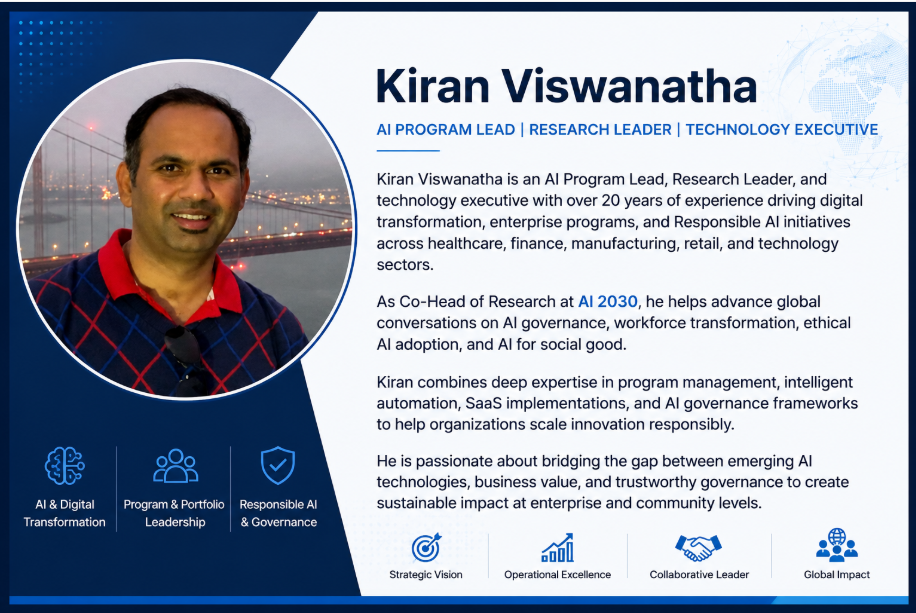
By Kiran Viswanatha