
February 14 2026 at 08:00AM
Confused Between LLMs, RAG, AI Agents, and MCP — Here’s the Simplest Way to Understand Them
Artificial Intelligence conversations today often sound like alphabet soup: LLMs, RAG, Agents, MCP. Many leadership and project teams hear these terms in strategy meetings but are unsure how they differ—or why they matter. Understanding the distinction is not just technical curiosity; it directly impacts automation strategy, productivity, cost optimization, and competitive advantage.
Let’s break it down in the simplest possible way.
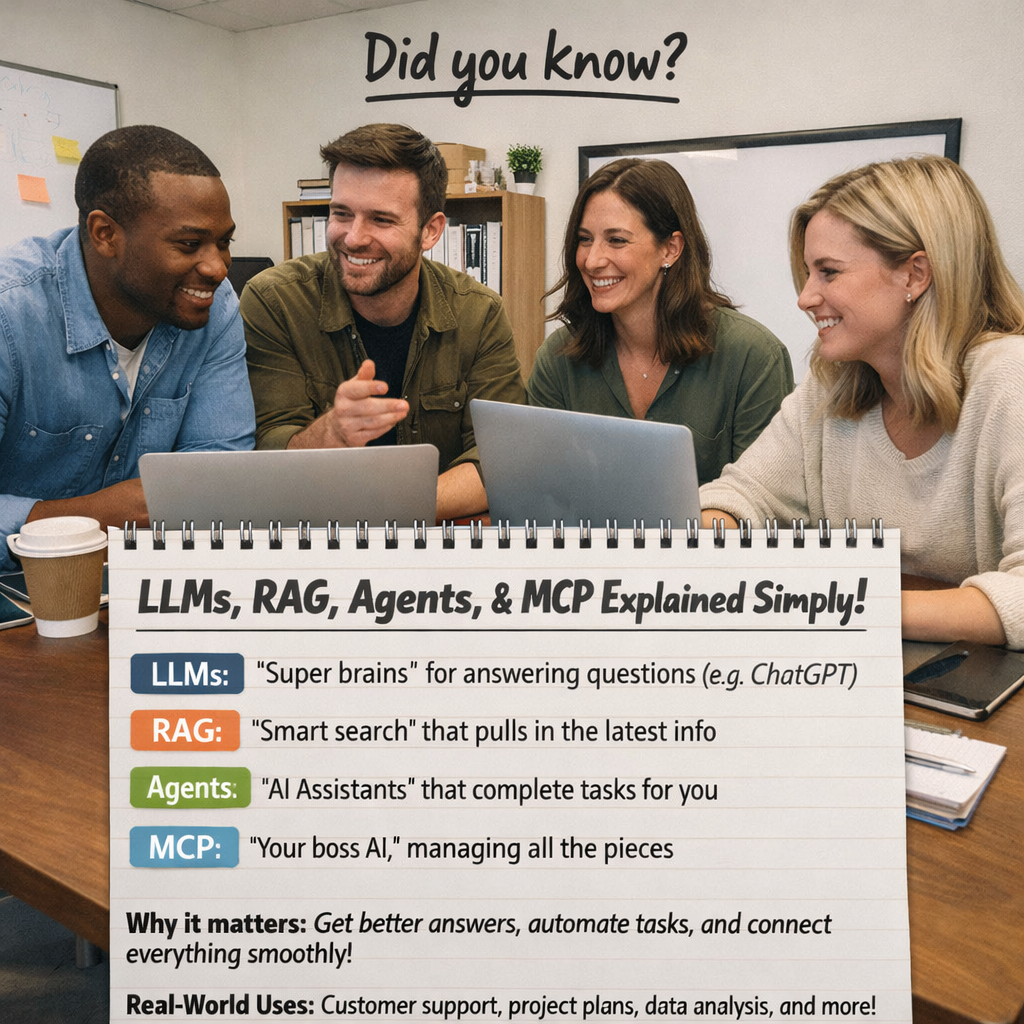
- LLMs – The “Brain”
Large Language Models (LLMs) are the foundation. They generate text, summarize information, write code, analyze documents, and answer questions.
Think of LLMs as:
A highly knowledgeable analyst who can draft reports, respond to queries, and synthesize information quickly.
Leadership relevance:
- Faster document analysis
- Meeting summaries and insights
- Drafting proposals, emails, and reports
Example:
A program manager uploads a 200-page RFP, and the LLM produces a structured executive summary in minutes.
- RAG – The “Research Assistant”
Retrieval-Augmented Generation (RAG) enhances LLMs by connecting them to your organization’s internal data—policies, knowledge bases, contracts, or operational data.
Think of RAG as:
Giving the analyst access to your company’s internal library so responses are accurate and organization-specific.
Leadership relevance:
- Enterprise knowledge assistants
- Accurate policy and compliance answers
- Faster onboarding knowledge access
Example:
A delivery leader asks: “What is our escalation policy for Tier-1 customers?”
RAG retrieves the latest policy document and generates an accurate answer.
- AI Agents – The “Doers”
AI Agents don’t just answer questions—they take actions, execute workflows, and complete tasks across systems.
Think of agents as:
Digital team members that perform assigned tasks autonomously.
Leadership relevance:
- Automated reporting
- Vendor onboarding workflows
- Ticket resolution automation
- Multi-step approvals and follow-ups
Example:
An AI agent gathers weekly project metrics from multiple tools, generates dashboards, emails stakeholders, and schedules review meetings automatically.
- MCP – The “Coordinator”
MCP (Model/Agent Communication Platforms or Multi-Capability Platforms) orchestrate multiple agents and tools, ensuring systems work together seamlessly.
Think of MCP as:
The program manager coordinating multiple AI assistants to deliver an outcome.
Leadership relevance:
- Enterprise-scale automation orchestration
- Multi-system coordination
- Governance, control, and monitoring
Example:
A customer onboarding process triggers several agents—documentation validation, compliance checks, account setup, and welcome communication—coordinated through a central orchestration layer.
Why Leaders Should Care
Understanding these concepts enables leadership teams to move from isolated AI experiments to enterprise automation strategies.
Business impact:
- Faster decision-making through intelligent insights
- Reduced operational overhead via automation
- Improved employee productivity
- Scalable digital workforce capabilities
Organizations that understand the difference between LLMs (thinking), RAG (knowing), Agents (doing), and MCP (coordinating) are better positioned to design practical AI roadmaps instead of chasing fragmented tools.
A Simple One-Line Summary
- LLMs: Generate intelligence
- RAG: Bring enterprise knowledge
- Agents: Execute tasks
- MCP: Coordinate everything together
Final Thought for Leadership Teams
AI transformation is no longer about adopting a single tool—it’s about building intelligent systems that think, know, act, and collaborate. Leaders who understand this stack can identify high-value automation opportunities faster, prioritize investments better, and drive measurable business outcomes.
The question is no longer “Should we use AI?”
It is “Which combination of LLMs, RAG, Agents, and orchestration will deliver the biggest strategic advantage for us?”
By Kiran Viswanatha
LinkedIn: https://www.linkedin.com/in/kiran-v-79a09630/
Experience in Agentic Process Management (APM) role to automate and optimize workflows,process analysis, and integrations leading to more efficient and adaptable business processes.
Experience implementing various SAAS solutions especially Salesforce Service Cloud platform to meet specific customer service needs, enhancing automation, personalized support, seamless customer experiences.
Proficiency in Master Data Management and Python, coupled with a strong foundation in Cybersecurity, empowers to drive significant process enhancements and strategic automation initiatives.