September 04 2026 at 10:01AM
Digital Metempsychosis: When Old Business Logic Acquires an AI Soul
How AI is transforming legacy rules, workflows, and decisions into adaptive digital intelligence
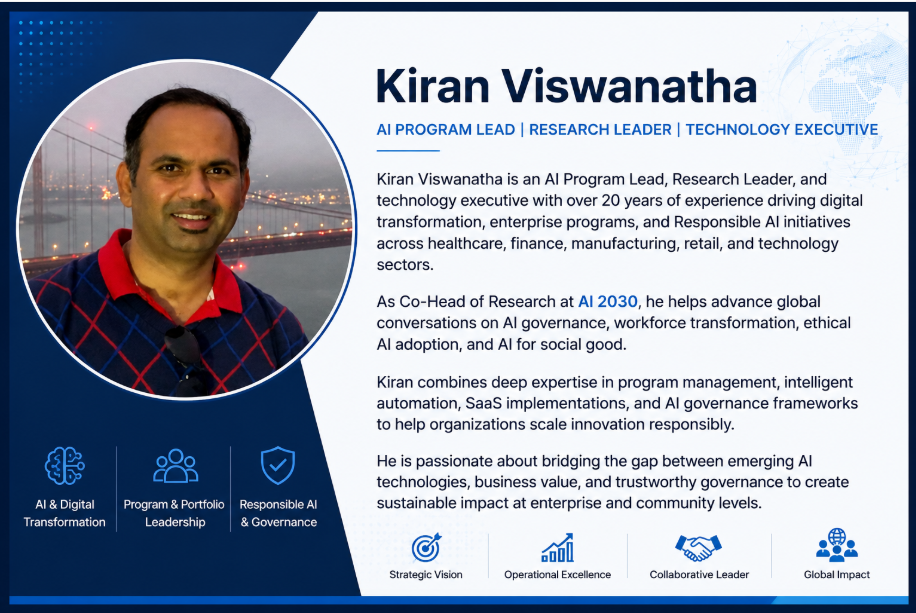
By Kiran Viswanatha
AI Program Leadership | Responsible AI | Research & Governance
“AI transformation does not always begin with replacing the old. Sometimes, it begins by giving the old a new form of intelligence.”
What if the next great AI transformation isn't about building something completely new?
What if it is about taking the business logic organizations have accumulated over decades—rules, policies, workflows, decision trees, approval mechanisms, customer knowledge, operational practices—and giving them a new intelligent interface?
This idea can be described as Digital Metempsychosis.
The term metempsychosis traditionally refers to the transmigration of a soul from one form into another. Applied metaphorically to digital transformation, it describes something fascinating:
Old business logic can acquire a new AI-enabled form without losing the organizational knowledge embedded within it.
A 20-year-old underwriting rule can become an intelligent decision-support service.
A decades-old customer-service workflow can become an AI-assisted conversational process.
A complex procurement policy can become an intelligent policy assistant.
A legacy knowledge base can become a contextual enterprise intelligence layer.
The technology changes.
The organizational knowledge survives.
And sometimes, that combination creates something much more powerful than either the legacy system or AI alone.
Did You Know?
Many organizations don't actually have an AI shortage.
They have an institutional knowledge problem.
Their business logic is scattered across:
- legacy applications;
- SQL procedures;
- spreadsheets;
- policy documents;
- SOPs;
- workflow engines;
- email approvals;
- tribal knowledge;
- compliance rules;
- decision trees;
- experienced employees.
Some of this logic may be 10, 20, or even 30 years old.
Replacing everything isn't realistic.
But simply connecting an LLM to those systems isn't transformation either.
The opportunity is to ask:
Can AI understand, contextualize, and safely interact with the business logic we already possess?
That is where Digital Metempsychosis begins.
- The Business Logic We Forgot We Had
Every mature organization has accumulated what could be called Digital DNA.
Consider a bank.
Its systems may contain rules for:
- customer eligibility;
- credit assessment;
- fraud detection;
- transaction limits;
- regulatory compliance;
- loan approval;
- risk classification.
Consider healthcare.
The organization may have:
- clinical workflows;
- authorization rules;
- payer policies;
- appointment protocols;
- patient communication procedures.
Consider manufacturing.
There may be:
- quality thresholds;
- machine maintenance rules;
- production constraints;
- supplier requirements;
- safety procedures.
This isn't merely software.
It is organizational knowledge encoded into software.
- The Traditional Approach: Replace Everything
For years, digital transformation often followed this pattern:
Legacy System
↓
Migration
↓
Modern Platform
↓
New Application
↓
New Workflow
↓
New Business Logic
This can be expensive, slow, and risky.
And there is an uncomfortable question:
What happens to the business knowledge embedded in the old system?
Sometimes organizations migrate the data but lose the reasoning.
That's a dangerous form of modernization.
- The AI Approach: Give the Logic a New Interface
AI introduces another possibility.
Instead of immediately replacing the business logic, organizations can create an intelligence layer around it.
For example:
The AI doesn't necessarily become the source of truth.
Instead:
AI becomes the interpreter, orchestrator, and assistant around trusted enterprise logic.
That distinction is extremely important.
- AI Doesn't Need to Replace Business Logic
Imagine a procurement organization with 500 pages of purchasing policies.
An employee asks:
"Can I purchase this software using my department budget?"
A conventional approach requires the employee to search policies and interpret them.
An AI-enabled approach could:
- understand the employee's question;
- retrieve the relevant policy;
- understand organizational context;
- identify applicable rules;
- explain the reasoning;
- identify required approvals;
- initiate the appropriate workflow.
The underlying policy hasn't disappeared.
It has acquired an intelligent interface.
That is Digital Metempsychosis.
- The Difference Between Automation and Digital Metempsychosis
These concepts are related but different.
Traditional Automation
"When X happens, execute Y."
AI Automation
"Interpret X and determine the appropriate action."
Digital Metempsychosis
"Preserve the organization's existing knowledge and business logic while transforming how humans and intelligent systems interact with it."
The third concept focuses on continuity of organizational intelligence.
- Real-World Example: Banking
Consider loan processing.
A traditional system might require employees to navigate:
- multiple screens;
- credit systems;
- policy manuals;
- eligibility rules;
- risk systems.
An AI layer could allow an employee to ask:
"Why was this application flagged?"
The system could retrieve relevant evidence from approved sources and explain:
- applicable eligibility criteria;
- missing information;
- relevant risk indicators;
- required next steps.
The AI doesn't invent the bank's policy.
It makes the existing policy more accessible and actionable.
That can improve:
- employee productivity;
- decision consistency;
- customer experience;
- training;
- transparency.
- Real-World Example: Customer Service
Many enterprises have decades of customer-service knowledge.
It's often buried inside:
- FAQs;
- knowledge bases;
- product manuals;
- ticket histories;
- SOPs;
- CRM records.
A generative AI assistant can provide a conversational interface over this knowledge.
Instead of searching:
"Which policy applies to this customer?"
the service representative can ask:
"What options are available for this customer's situation?"
The AI can retrieve relevant information and provide a structured recommendation.
Again:
The knowledge isn't replaced. Its accessibility is transformed.
- Real-World Example: Manufacturing
Imagine a manufacturing organization with decades of operational knowledge.
A technician encounters an unusual equipment condition.
Historically, they might:
- call an experienced engineer;
- search manuals;
- review maintenance logs;
- inspect historical records.
An AI-enabled industrial assistant could combine approved sources such as:
- equipment manuals;
- maintenance history;
- sensor information;
- troubleshooting procedures;
- safety protocols.
The result isn't simply:
"AI says replace component X."
A responsible system should instead provide:
Evidence → reasoning → recommended action → confidence/uncertainty → required human approval.
That is where AI and governance meet.
- The Risk: Giving an AI Soul Without Giving It Governance
The metaphor sounds exciting.
But it introduces a critical warning.
If organizations give AI access to business processes without appropriate controls, they may accidentally transform:
old business logic + AI
into
old business logic + AI + uncontrolled autonomy.
That's not responsible transformation.
It is amplified risk.
A mature Digital Metempsychosis approach therefore needs:
- identity;
- authorization;
- data access controls;
- provenance;
- auditability;
- human oversight;
- policy enforcement;
- monitoring;
- exception handling.
Intelligence should evolve faster than authority.
- The "AI Soul" Is Not the LLM
The phrase AI soul is metaphorical.
The model itself should not become the organization's source of truth.
The "soul" is better understood as the intelligent experience created around organizational knowledge.
Think of it this way:
Legacy system = institutional memory
Business rules = organizational judgment
Enterprise data = organizational evidence
AI = intelligent interaction layer
Governance = organizational conscience
Together, they create a new form of enterprise capability.
- Why This Matters to Project Managers
Project managers are increasingly responsible for transformation initiatives where AI is involved.
Understanding Digital Metempsychosis can change how you approach modernization.
Instead of asking:
"What system are we replacing?"
ask:
"What organizational intelligence are we carrying forward?"
Before retiring a legacy application, identify:
What knowledge does it contain?
What decisions does it support?
What rules does it enforce?
What exceptions have accumulated over time?
Which assumptions are still valid?
Which rules are obsolete?
Which capabilities should become AI-enabled?
These questions can dramatically improve transformation outcomes.
- The Legacy System Is Not Always the Enemy
One of the biggest mistakes in transformation is assuming:
Old = bad
Sometimes:
Old technology + valuable business knowledge
is worth preserving.
The technology may be outdated.
But the knowledge embedded inside it may be extremely valuable.
The transformation challenge becomes:
Separate the knowledge from the technical limitations.
That's where AI can become a bridge.
- From Legacy Modernization to Knowledge Modernization
This creates an interesting shift.
Traditional modernization asks:
"How do we modernize our applications?"
Digital Metempsychosis asks:
"How do we modernize the way organizational knowledge is experienced, governed, and applied?"
This is a much broader transformation.
It connects:
Legacy systems
→ Data
→ Business rules
→ Context
→ AI
→ Workflows
→ Human judgment
→ Business outcomes
- The Role of Context
AI without context can produce generic answers.
Enterprise AI needs to understand:
- who is asking;
- what they are trying to accomplish;
- which business process applies;
- what data they are authorized to access;
- which policies apply;
- what stage the process is in.
Therefore:
Context becomes the bridge between AI capability and enterprise reality.
For project managers, this means AI implementation cannot be treated purely as a model deployment.
It becomes a context engineering + process + data + governance initiative.
- The New Architecture of Enterprise Intelligence
A mature enterprise AI architecture may increasingly look like:
The AI sits inside a governed ecosystem.
It doesn't sit above the organization.
- What Leadership Should Measure
Traditional transformation metrics include:
- cost reduction;
- system uptime;
- migration percentage;
- deployment velocity.
AI-enabled transformation should add:
Knowledge preservation
Did we preserve critical organizational knowledge?
Decision quality
Are decisions becoming more consistent and evidence-based?
Adoption
Are employees actually using the new capability?
Explainability
Can users understand why recommendations were produced?
Governance
Can we demonstrate appropriate authorization and accountability?
Business value
Are measurable outcomes improving?
- The New Project Charter Question
Every AI transformation project should consider adding one question to its charter:
"What existing organizational intelligence are we transforming rather than replacing?"
This single question can uncover enormous value.
For example:
Existing asset: 20 years of customer service knowledge.
Transformation: AI service assistant.
Value: Faster resolution + better employee enablement.
- Digital Metempsychosis and Workforce Transformation
There is another important dimension.
Experienced employees often carry enormous amounts of tacit knowledge.
When they retire or change roles, organizations can lose that knowledge.
AI can potentially help capture and make parts of that knowledge accessible—provided the organization handles privacy, security, intellectual property, and human accountability appropriately.
Imagine an experienced engineer explaining:
"When this machine behaves like this, check these three things first."
That knowledge could potentially become part of a governed organizational knowledge system.
AI can help organizations preserve institutional memory.
But it should not pretend that tacit human expertise can be perfectly captured.
Some knowledge remains contextual, experiential, and human.
- The Responsible AI Perspective
Digital Metempsychosis should therefore follow a simple principle:
Preserve knowledge. Modernize interaction. Govern authority.
AI can:
- summarize;
- recommend;
- retrieve;
- reason over approved information;
- identify patterns;
- orchestrate workflows.
But organizations must define:
- what AI can access;
- what AI can recommend;
- what AI can execute;
- when human approval is required;
- how decisions are audited;
- what happens when AI is uncertain.
The goal isn't autonomous AI everywhere.
The goal is appropriate intelligence where it creates measurable value.
- A Practical Framework for Leaders
I propose a SOUL framework for Digital Metempsychosis:
S — Systems
Identify legacy systems and technologies containing valuable business knowledge.
O — Organizational Knowledge
Extract rules, processes, decisions, assumptions, and institutional knowledge.
U — Understanding Context
Define who, what, why, when, and under what conditions the knowledge should be applied.
L — Layered Governance
Define identity, authority, evidence, permissions, oversight, monitoring, and accountability.
The result:
Systems → Knowledge → Context → Governance → AI-enabled value
- Five Questions Before Giving Legacy Logic an AI Soul
Before launching an AI transformation, ask:
- What business logic already exists?
- Which parts remain valid?
- Which rules should never be overridden by AI?
- Where can AI add intelligence without becoming the authority?
- How will we prove that the resulting system is trustworthy?
These questions should be answered before selecting the LLM.
- The Future of Enterprise AI May Be Less About "Building AI"
Perhaps the biggest misconception about enterprise AI is that every organization needs to build something completely new.
In many cases, the greater opportunity may be:
AI-ifying what already works.
The organization already possesses:
- customers;
- processes;
- data;
- policies;
- domain expertise;
- business rules;
- workflows.
AI can become the layer that makes these assets:
searchable → contextual → conversational → predictive → adaptive
while governance determines where adaptation is permitted.
Conclusion: Give the Past a Responsible Future
Digital transformation has often been described as replacing the old with the new.
But AI gives organizations another option.
Transform the old into something intelligent.
The legacy system may eventually disappear.
The spreadsheet may disappear.
The manual workflow may disappear.
The old interface may disappear.
But the organizational knowledge doesn't have to disappear.
It can be:
extracted → contextualized → governed → augmented → reused.
That is Digital Metempsychosis.
The future of enterprise AI may not belong only to organizations that build the newest models. It may belong to organizations that know how to give their accumulated knowledge a new form.
For project managers and AI leaders, the challenge is therefore not simply:
"How do we implement AI?"
It is:
"How do we transform decades of organizational intelligence into a new AI-enabled capability—without losing the knowledge, governance, accountability, and human judgment that made the organization successful in the first place?"
Because the most powerful AI transformation may not be the creation of something entirely new.
It may be the reincarnation of something the organization already knows.
The technology gets a new form.
The knowledge gets a new life.
Governance gives it boundaries.
And the organization gets a new capability.
That is Digital Metempsychosis.