August 03 2026 at 09:20AM
Disciplined AI: Turning AI Ambition into Responsible Project Execution
Artificial Intelligence is no longer a futuristic concept waiting for organizations to discover its potential. It is already influencing how we plan projects, analyze risks, automate workflows, engage customers, manage resources, and make decisions.
Yet, as AI adoption accelerates, a critical question emerges:
Are we managing AI with enough discipline to ensure that it delivers sustainable value?
For project managers, this question is becoming increasingly important.
The challenge is no longer simply how to use AI. The real challenge is how to use AI consistently, responsibly, securely, and measurably—without losing control of the project, the people, or the outcomes.
This is where the concept of Disciplined AI becomes relevant.
Disciplined AI is the practice of applying structured project management thinking, governance, risk management, human oversight, and continuous improvement to AI-enabled initiatives. It is about balancing innovation with accountability and speed with control.
In simple terms:
Disciplined AI means using AI with purpose, process, people, and governance—not simply because the technology is available.
Why Should Project Managers Care About Disciplined AI?
Project managers are increasingly becoming the bridge between business strategy, technology teams, leadership, and end users.
When an organization launches an AI initiative, the project manager may be responsible for coordinating:
- Business objectives
- AI and data teams
- Technology implementation
- Security and privacy
- Compliance
- Vendor management
- Change management
- Stakeholder expectations
- User adoption
- Risk and issue management
This means AI is not only a technology conversation.
It is a project delivery conversation.
An AI model may be technically impressive but still fail as a project because the business problem was poorly defined, data quality was inadequate, users rejected the solution, or governance was introduced too late.
Disciplined AI helps project managers ask the right questions before the project becomes difficult to control.
From "Can We Build It?" to "Should We Build It?"
Traditional technology projects often begin with a question:
Can we build this?
AI projects require an additional question:
Should we build this, and under what conditions?
For example, imagine a project team proposing an AI system to automatically screen job applicants.
Technically, the system may be feasible.
But a disciplined AI approach asks:
- Is the training data representative?
- Could historical hiring bias be reproduced?
- Can candidates understand how decisions are made?
- Is there a human review process?
- What happens when the model is wrong?
- Who is accountable for the final decision?
- How will the model be monitored after deployment?
- Are privacy and regulatory requirements addressed?
The project manager's role is not to become the AI scientist.
The role is to ensure that the right questions are asked at the right time.
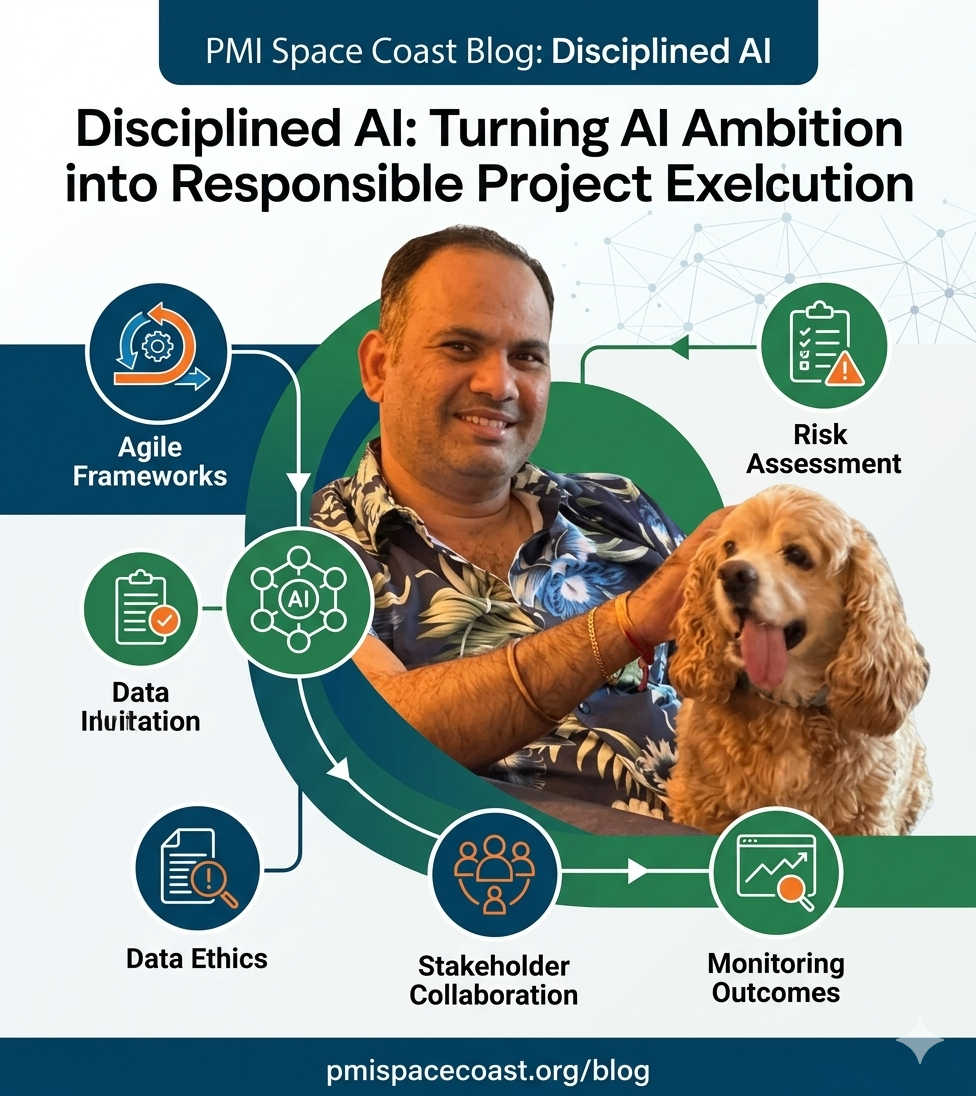
The Five Pillars of Disciplined AI
I propose five practical pillars that project managers can use when managing AI-enabled initiatives.
- Purpose: Start With the Business Problem
AI should not be the starting point.
The starting point should be the problem.
A disciplined AI project begins by defining:
Business Problem → Desired Outcome → AI Opportunity → Success Measures
For example:
A manufacturing organization may not need "an AI platform."
Its real problem may be:
"Unplanned equipment downtime is affecting production schedules and increasing operational costs."
The AI opportunity could then be predictive maintenance.
The project success measures might include:
- Reduction in unplanned downtime
- Improvement in maintenance planning
- Reduction in false alarms
- Increase in equipment availability
The lesson for project managers is simple:
Do not measure AI adoption alone. Measure business value.
- Data: AI Is Only as Strong as Its Data Foundation
Data is the fuel of many AI systems.
But data can also become a project's greatest risk.
Project managers should consider:
- Data quality
- Data completeness
- Data ownership
- Data lineage
- Data privacy
- Data access
- Data bias
- Data retention
- Data security
Consider a financial services organization developing an AI system to detect suspicious transactions.
If historical data contains inconsistent classifications or incomplete records, the AI system may produce unreliable results.
A disciplined project manager should therefore ensure that data readiness is treated as a project milestone, not as an assumption.
A useful project gate could be:
No production AI deployment without demonstrated data readiness.
This simple principle can prevent significant downstream problems.
- Governance: Build Guardrails Before You Need Them
Governance is often perceived as something that slows innovation.
In reality, good governance can enable innovation at scale.
Without governance, every AI project may create its own approach to:
- Data access
- Model approval
- Risk assessment
- Documentation
- Human oversight
- Monitoring
- Incident management
This creates fragmentation.
Disciplined AI introduces common guardrails.
A project manager can establish governance checkpoints such as:
Idea → Risk Assessment → Data Assessment → Development → Validation → Human Review → Deployment → Monitoring
The goal is not to create unnecessary bureaucracy.
The goal is to ensure that the project can answer:
Who approved this AI system, why was it approved, what risks were identified, and who is accountable after deployment?
That is the foundation of responsible AI delivery.
- Human Oversight: Keep People Accountable
One of the most important principles of Disciplined AI is that automation should not automatically mean elimination of human judgment.
The right question is:
Where should humans remain in the decision loop?
For some AI applications, AI can provide recommendations.
For others, AI can automate routine decisions.
For high-impact decisions, however, meaningful human oversight may be essential.
Consider healthcare.
An AI system may identify patterns in medical images or patient data. It can support clinicians, but the project's governance model should define:
- When AI recommendations can be accepted
- When human review is mandatory
- How disagreements are handled
- How errors are documented
- Who is accountable for the final decision
The project manager should ensure that the human-in-the-loop model is designed as part of the workflow, rather than added as an afterthought.
- Continuous Monitoring: Project Completion Is Not AI Completion
Traditional projects often have a clear end date.
AI systems are different.
An AI system can change in performance as:
- Data changes
- User behavior changes
- Business conditions change
- Models are retrained
- New risks emerge
Therefore, the project manager should think beyond implementation.
A disciplined AI lifecycle is:
Plan → Build → Validate → Deploy → Monitor → Learn → Improve
Project success should include post-deployment measures such as:
- Model performance
- Accuracy
- Bias indicators
- User adoption
- Business outcomes
- Security incidents
- Data drift
- Model drift
- Human override rates
The project may be delivered.
But the AI system is still living.
A Real-World Example: AI in Customer Service
Imagine an organization implementing a generative AI assistant for customer service representatives.
The business goal is to reduce response time and improve customer experience.
A traditional technology project might focus on:
- Selecting the AI platform
- Integrating the system
- Testing the interface
- Deploying the solution
A Disciplined AI project adds additional questions.
Before Deployment
- What customer data can the AI access?
- What information must be protected?
- How will sensitive information be handled?
- What sources can the AI use?
- How will incorrect answers be detected?
During Deployment
- Can customer service agents override AI recommendations?
- How are AI-generated responses reviewed?
- What happens when the AI produces inaccurate information?
After Deployment
- Are customers receiving correct answers?
- Are agents over-relying on AI?
- Are hallucinations increasing?
- Is customer satisfaction improving?
- Are there measurable productivity gains?
The project manager is therefore not just managing an implementation.
The project manager is managing an AI-enabled operating model.
Another Example: AI in Project Management
AI itself can also become a project manager's productivity partner.
Imagine using AI to analyze project data and identify early warning signals.
The system could analyze:
- Schedule variance
- Resource utilization
- Risk registers
- Issue logs
- Budget trends
- Dependency delays
- Stakeholder sentiment
The AI may identify a potential risk:
"The probability of missing the next milestone has increased."
A disciplined project manager does not automatically accept the prediction.
Instead, the manager asks:
- What evidence supports this prediction?
- What data was analyzed?
- Is the information current?
- What assumptions were made?
- Can the team validate the risk?
- What action should be taken?
AI becomes a decision-support capability, not a replacement for project leadership.
Disciplined AI and the Project Management Triangle
The traditional project management triangle focuses on:
Scope + Schedule + Cost
AI projects introduce additional dimensions.
A more complete model may consider:
Scope + Schedule + Cost + Data + Risk + Trust
A project can be delivered:
- On time
- On budget
- Within scope
…and still fail if users do not trust the AI or if the system creates unacceptable risks.
This is why project managers need to expand their definition of project success.
The new question is not simply:
"Did we deliver the project?"
It is:
"Did we deliver a solution that creates sustainable value and can be trusted over time?"
A Practical Disciplined AI Checklist for Project Managers
Before launching an AI initiative, ask:
Purpose
- What business problem are we solving?
- Why is AI the right solution?
- What does success look like?
Data
- Do we have the right data?
- Is the data reliable and representative?
- Who owns the data?
Risk
- What could go wrong?
- What are the consequences of failure?
- What risks require escalation?
Governance
- Who is accountable?
- Who approves the AI system?
- What policies and controls apply?
Human Oversight
- Where must humans remain involved?
- Can users challenge or override AI decisions?
- What happens when AI is uncertain?
Security and Privacy
- What information is being processed?
- Who can access it?
- How is sensitive information protected?
Monitoring
- How will we know if the AI is performing correctly?
- What happens if performance declines?
- Who monitors the system after launch?
Value
- Are we achieving the expected business outcome?
- Can we demonstrate measurable benefits?
- Should the AI system be expanded, modified, or stopped?
The Role of the Project Manager Is Evolving
The emergence of AI does not make project management less important.
It makes disciplined project leadership more important.
Project managers are uniquely positioned to connect:
Strategy → Technology → People → Governance → Value
As AI becomes embedded into organizational processes, project managers will increasingly need to understand concepts such as:
- Responsible AI
- AI governance
- Data governance
- Model risk
- Human oversight
- AI ethics
- AI lifecycle management
- AI security
- Change management
They do not need to become AI engineers.
But they do need enough AI literacy to ask the questions that protect the project and the organization.
The Future Belongs to Disciplined AI
The AI era will not be defined only by organizations that adopt AI the fastest.
It will be defined by organizations that can scale AI responsibly and sustainably.
Disciplined AI provides a mindset for achieving that balance.
It reminds us that innovation without governance can create risk.
Governance without innovation can create stagnation.
And AI without human accountability can create outcomes that no one truly owns.
For project managers, the opportunity is significant.
We can become the leaders who ensure that AI initiatives are not just technically successful—but valuable, responsible, measurable, explainable, and trusted.
The future of AI project delivery is therefore not simply about building smarter systems.
It is about building better systems with discipline.
AI may provide the intelligence.
Discipline provides the direction.
Governance provides the guardrails.
And project leadership turns all three into sustainable value.
That is the promise of Disciplined AI.