March 15 2026 at 10:00AM
Issue and Risk Management at Orbital Altitude: What PMP Professionals Can Learn from SpaceX Crew-11 & Crew-12 Missions
Current Events
Best Practices / Lessons Learned
🚀 Issue and Risk Management at Orbital Altitude
What PMP Professionals Can Learn from SpaceX Crew-11 & Crew-12 Missions
When project managers talk about high-stakes delivery, few environments rival human spaceflight. The recent Crew-11 and Crew-12 missions to the International Space Station (ISS)—executed by SpaceX—offer a masterclass in precision planning, risk mitigation, stakeholder coordination, and execution under uncertainty.
For PMP-certified professionals, these missions are not just space achievements—they are textbook examples of world-class program and project management operating at scale.
Crew 11 :
The crew for the SpaceX Crew-11 mission (Flight 212) consisted of the following four members:
* Zena Cardman (NASA) – Commander
* Michael Fincke (NASA) – Pilot
* Kimiya Yui (JAXA) – Mission Specialist
* Oleg Platonov (Roscosmos) – Mission Specialist
They launched on August 1, 2025, and returned to Earth on January 15, 2026.
This was an early return and we will discuss why this occurred in the following sections.
Crew12:
Crew-12 Mission Details (Launched Feb 13, 2026)
Rocket: Falcon 9 (Booster B1101)
Spacecraft: Dragon Freedom
Crew: Jessica Meir, Jack Hathaway, Sophie Adenot, and Andrey Fedyaev.
Destination: International Space Station (ISS).
Key Achievement: First booster landing at Landing Zone 40 (LZ-40) in Space Coast Florida.
Starship Flight 12 (Upcoming)
Target Date: March 2026.
Vehicles: Ship 39 and Booster 19.
Hardware: First flight of the Starship Version 3 architecture.
Primary Goals: Orbital flight testing and in-space propellant transfer demonstrations. Replace crew 11 that returned early.
Questions for the PMP:
Do you have contingency plans baked into your long-term projects?
What style will risk management plan at you using ? Acceptance, avoidance, mitigation, escalating, or Transfer?
Remember:
Issues— are realized risked that have happened.
And
Risks — are potential issues that could occur.
Good project managers have logged these in a risk register and ranked them from 1-10. In a large-scale project typically the risks with the highest ranks have a mitigation plan and cost set aside to handle this as fast as possible.
Let's read further in the article to see how SpaceX handled this high-ranking issue
🤢🦠Why crew 11 returned early? PMPs preparing for the unthinkable.. (When a realized risk turns to an issue)
SpaceX Crew-11 returned early on January 15, 2026, due to an undisclosed medical issue involving one crew member. Although the individual was reported as stable, NASA chose a ("controlled medical evacuation"—mitigation plan) to ensure they could receive diagnostic care unavailable in microgravity.
Key details regarding the early return:
Medical Concern: A "serious medical issue" was identified on January 7, leading to the cancellation of two scheduled spacewalks.
Cautionary Measure: NASA Administrator Jared Isaacman clarified it was not an emergency deorbit but a cautious move to prioritize astronaut health.
Mission Impact: The crew spent 167 days in space, returning about one month ahead of their original February schedule.
Historical Note: This marked the first time a mission was cut short for medical reasons in the 25-year history of the International Space Station.
🧭 Program Governance Across Sequential Crews
Crew-11 and Crew-12 were not standalone projects—they were interdependent deliverables within a long-running human spaceflight program.
From a PMP perspective:
Each crew rotation functioned as a phase gate
Knowledge transfer between crews mirrored formal project closeout → initiation cycles
Mission continuity depended on tight configuration management and documentation discipline
This is program management excellence—where scope, cadence, and operational readiness must remain intact across multiple execution waves.
📅 Schedule Management Where “Delay” Is Not an Option
Unlike terrestrial projects, launch windows are non-negotiable constraints driven by orbital mechanics, weather, and ISS alignment.
Crew-11 and Crew-12 demonstrate:
Critical Path Method (CPM) executed under immutable external dependencies
Aggressive use of schedule compression techniques without sacrificing safety
Real-time replanning backed by decision authority clarity
For PMPs, this reinforces a core truth: a realistic schedule is not flexible—it’s resilient.
⚠️ Risk Management at the Extreme Edge
Risk registers for spaceflight go far beyond cost and schedule—they include human life, orbital debris, system redundancy, and international coordination.
Key takeaways:
Risks were identified early, quantified, and continuously monitored
Mitigation strategies relied on design redundancy, simulation, and rehearsal
Residual risk was formally accepted only with executive and stakeholder sign-off
This is PMI’s Risk Management framework applied at its highest possible consequence level.
🤝 Stakeholder Management Across Nations & Organizations
Crew-11 and Crew-12 required alignment across:
Space agencies
International partners
Engineering teams
Medical, logistics, and flight operations
The ISS itself is a multi-national stakeholder environment, making communication planning critical.
From a PMP lens:
Stakeholder power/interest matrices were dynamic, not static.
Communication plans had to account for time zones, languages, and operational cultures.
Trust and clarity were treated as project assets. Fast action is required when dealing with risk at this level. This is why it is crucial to have a weighted risk register. Have your most important/high impact risks that rate 10 or higher at the top of the list (with moneys & resources set aside to act fast) , and your lower rated risk at the bottom with —lower money amounts/ allocations set side, should the budget be low. This doesn't mean to not plan for these risks but lower amounts of resources can be applied here , if you can apply resources to all risks.
🔄 Agile Thinking Within a Waterfall Reality
While human spaceflight follows strict stage-gate governance, SpaceX’s execution model integrates Agile principles:
Rapid iteration in testing,
Continuous improvement between Crew-11 and Crew-12, and feedback loops embedded into post-mission reviews.
This hybrid approach is a strong example of tailoring PM methodology, a core PMP competency.
📊 Quality Management = Mission Success
Quality wasn’t inspected in—it was engineered, validated, and verified repeatedly.
Crew-11 and Crew-12 highlight:
Relentless quality assurance over quality control,
acceptance criteria that leave zero ambiguity, and
verification processes treated as mission-critical deliverables.
For PMPs, this underscores that quality failures at scale become systemic risks.
🏁 Lessons for PMP Professionals
These missions reinforce timeless PMP principles:
✔ Governance enables speed
✔ Risk management is a team responsibility
✔ Always be keen to the cost of non-conformance
✔ Communication is a system, not a just soft skill
✔ Lessons learned must feed forward—not sit in archives
Crew-11 and Crew-12 remind us that great project management doesn’t just deliver outputs—it sustains operations, protects people, and advances entire systems.
Sources 🗃️
SpaceX.com
Kennedyspacecenter.com
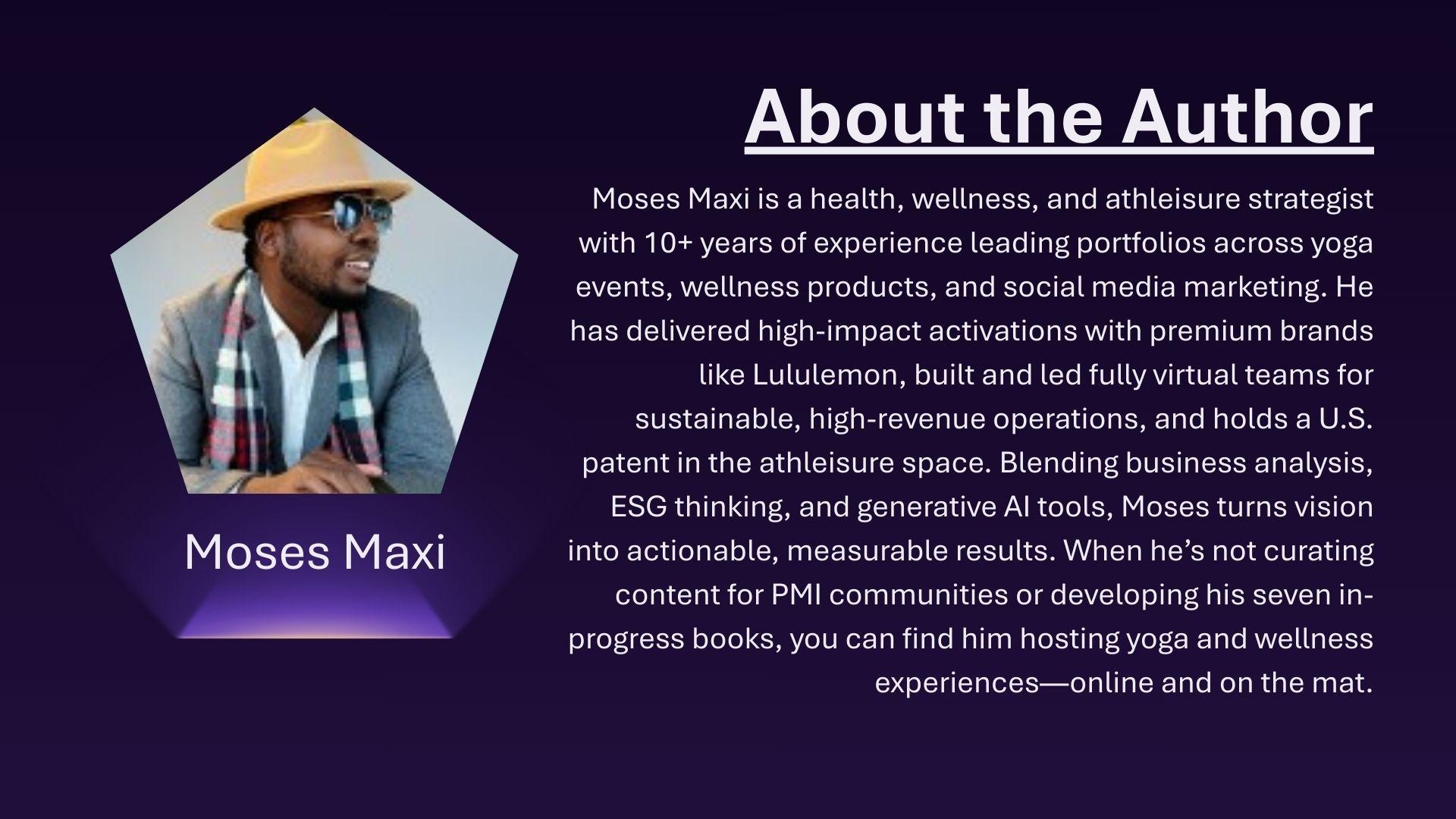
Moses Maxi, PMP ® CEO
NOSyoga
NOS Athleisure LLC
Subject
Matter Expert | PMI standards+ content writer | Global Headquarters - Project management Institute (2026) - Present (Remote)
Lululemon collaboration w/ @Neveroffechedule—
https://youtube.com/shorts/VqRRpLtIrow?si=WwopeiUUWC5BujtW
Project of the year entry 2025 -
Sustainable - Athleisure
PMI.org/awards
MUST READ published Articles:
PMIspacecoast.org/blog