August 24 2026 at 09:46AM
Knowing what AI can do is a question of capability; deciding what AI should do is a question of responsibility.
A leadership perspective on AI capability, human judgment, governance, and the rise of agentic AI
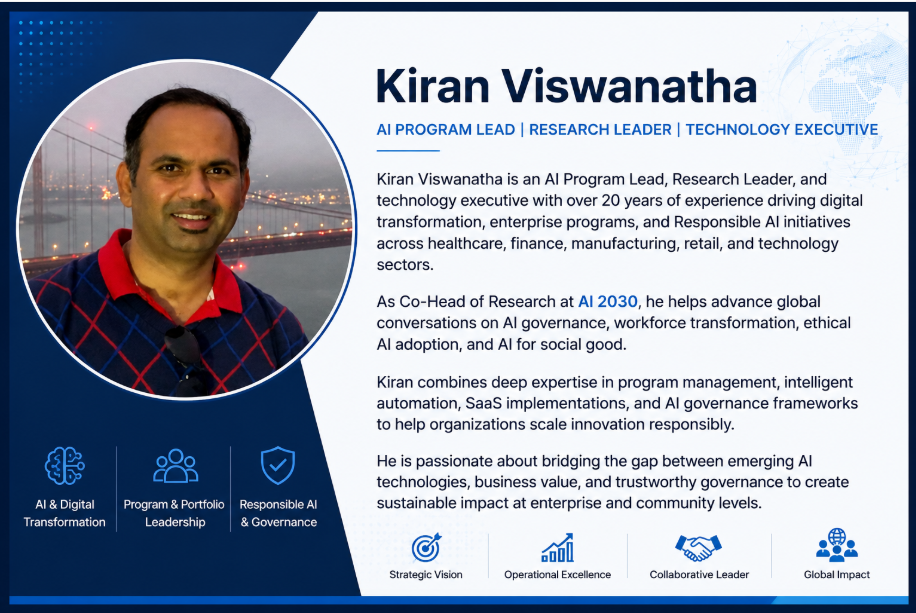
By Kiran Viswanatha
AI Leadership | Responsible AI | Research & Governance
“Knowing what AI can do does not mean you should decide what it should do.”
As artificial intelligence becomes increasingly capable, organizations are discovering an uncomfortable truth:
The hardest AI decisions are no longer technical decisions. They are leadership decisions.
AI can generate content, analyze data, predict outcomes, write software, identify patterns, recommend decisions, interact with customers, and increasingly take actions through AI agents.
But capability does not establish permission.
A system being technically capable of making a decision does not automatically mean it should make that decision.
This distinction—between capability and responsibility—may become one of the defining leadership questions of the AI era.
Did You Know?
For decades, technology was primarily evaluated by asking:
"Can we build it?"
Then organizations began asking:
"Can we automate it?"
With generative and agentic AI, the question is becoming:
"Should we allow AI to do it—and if so, under what conditions?"
That small change in wording represents a major shift in AI leadership.
- Capability Is Not Permission
Imagine an AI system that can analyze thousands of employee performance records and predict which employees are likely to leave.
Technically, it may be possible.
But should the organization use that prediction to:
- deny promotions?
- reduce training opportunities?
- terminate employees?
- label someone as a "flight risk"?
The technology may answer:
"I can predict."
Responsible leadership must ask:
"Should this prediction influence a person's career?"
That is no longer a machine-learning question.
It is a question of fairness, human dignity, accountability, privacy, organizational values, and governance.
- The AI Leadership Equation
A useful way to think about responsible AI is:
Capability + Context + Constraints + Human Judgment = Responsible Action
AI capability tells us what is technically possible.
Context tells us where and why the capability is being applied.
Constraints define what the system is not permitted to do.
Human judgment provides accountability for consequential decisions.
Without these elements, capability can easily become uncontrolled automation.
- The Evolution Makes This More Important
The distinction was important when AI primarily generated text.
It becomes critical when AI begins taking action.
Consider the evolution:
|
AI Generation |
What AI Does |
Leadership Question |
|
Rule-based chatbot |
Follows predefined rules |
Is the rule correct? |
|
Retrieval AI |
Finds information |
Is the information appropriate? |
|
Generative AI |
Creates content |
Can we trust the output? |
|
Copilot |
Supports humans |
Who makes the decision? |
|
Agentic AI |
Plans and acts |
What authority should AI have? |
|
Multi-agent systems |
Coordinate actions |
Who governs the ecosystem? |
The closer AI gets to action, the more important governance becomes.
- From Human-in-the-Loop to Human-in-Command
A common AI governance phrase is:
Human-in-the-loop.
But simply inserting a human somewhere in a workflow isn't necessarily meaningful oversight.
Imagine an AI reviews 10,000 applications and recommends 500 candidates.
A manager receives the recommendations and clicks:
Approve All
Technically, there was a human in the loop.
Practically, there may have been very little human judgment.
Responsible AI requires more than human presence.
It requires meaningful human authority.
For high-impact decisions, leaders should ask:
- Does the human understand what the AI is doing?
- Can they challenge the recommendation?
- Can they override it?
- Do they have enough information to make an informed decision?
- Is there sufficient time to exercise judgment?
- Is someone accountable for the outcome?
- Real-World Case: Hiring
Consider an organization implementing AI-assisted recruitment.
AI can potentially:
- screen resumes;
- summarize candidates;
- match skills to job descriptions;
- identify experience patterns;
- schedule interviews.
These are useful capabilities.
But suppose the system begins ranking candidates based on patterns learned from historical hiring decisions.
Now we have a problem.
If historical hiring practices contained bias, the AI may reproduce or amplify it.
The question is no longer:
"How accurate is the model?"
It becomes:
"What evidence are we allowing the model to use to influence people's employment opportunities?"
Project leadership lesson
Before deployment, the project team should define:
What AI may recommend.
What AI may not decide.
What requires human review.
How decisions can be challenged.
- Real-World Case: Healthcare
AI can potentially help clinicians:
- summarize medical information;
- identify patterns in imaging;
- prioritize cases;
- assist with documentation;
- support clinical decision-making.
The capability is valuable.
But a healthcare organization should not conclude:
"The AI is more accurate, therefore the AI should make the final decision."
Healthcare involves uncertainty, patient preferences, clinical context, ethical considerations, and accountability.
The better operating model is often:
AI provides evidence and assistance → qualified professional exercises judgment → accountable human makes the consequential decision.
The principle is simple:
AI can inform a decision without owning the decision.
- Real-World Case: Financial Services
Consider an AI system designed to detect potential financial fraud.
AI can analyze:
- transaction patterns;
- account behavior;
- geographic information;
- historical anomalies.
It may identify suspicious activity much faster than manual processes.
But imagine a false positive results in a legitimate customer's account being frozen.
The AI may have successfully detected an anomaly.
Yet the business decision still requires context.
Responsible implementation therefore needs:
- thresholds;
- human review;
- escalation;
- explainability;
- appeal mechanisms;
- audit trails.
The objective isn't to eliminate AI automation.
It is to place automation at the appropriate decision boundary.
- The Project Manager's Role Is Changing
This is where AI becomes especially relevant to project managers.
Historically, project managers were primarily concerned with:
- scope;
- schedule;
- cost;
- quality;
- risks;
- resources;
- stakeholders.
AI adds another dimension:
Decision Authority
A project manager increasingly needs to know:
Which decisions belong to AI, which belong to humans, and which require both?
That question should become part of project planning—not an afterthought during deployment.
- Add "AI Authority" to the Project Charter
Traditional project charters define:
- objectives;
- scope;
- stakeholders;
- assumptions;
- constraints;
- risks.
AI-enabled projects should additionally define:
AI Authority Boundary
What can the AI:
- see?
- recommend?
- generate?
- modify?
- approve?
- execute?
- escalate?
For example:
|
Activity |
AI Authority |
Human Authority |
|
Summarize project status |
✅ |
Review |
|
Identify potential risks |
✅ |
Validate |
|
Recommend mitigation |
✅ |
Decide |
|
Update a draft plan |
✅ |
Approve |
|
Change baseline |
❌ |
✅ |
|
Approve budget |
❌ |
✅ |
|
Terminate vendor |
❌ |
✅ |
This simple exercise can prevent enormous governance problems later.
- The "Should AI?" Test
Before introducing AI into a workflow, project teams can ask five questions.
- Can AI do it?
Capability
Does the technology technically support the task?
- Should AI do it?
Purpose
Does AI involvement create meaningful value?
- Should AI decide it?
Authority
Is this an appropriate decision for AI?
- What happens if AI is wrong?
Risk
What is the consequence of an incorrect output or action?
- Who is accountable?
Governance
Which human or organizational function owns the outcome?
This converts AI governance from an abstract principle into a project-management practice.
- Not Every AI Problem Needs an Agent
This is particularly important in today's enthusiasm around agentic AI.
An organization may say:
"Let's build an AI agent."
But perhaps the actual requirement is simply:
"Send a weekly project reminder."
A conventional workflow may be:
- cheaper;
- more predictable;
- easier to test;
- easier to govern.
Similarly, a retrieval system may be more appropriate than a fully autonomous agent for a controlled knowledge-base use case.
The principle:
Use the least autonomous technology capable of achieving the desired outcome safely.
If a workflow can be solved with deterministic automation, don't introduce unnecessary autonomy simply because an agent is technically possible.
- The Goldilocks Principle of AI Autonomy
We can think about AI autonomy as a spectrum.
LOW AUTONOMY HIGH AUTONOMY
AI observes → AI recommends → AI drafts → AI acts → AI acts autonomously
│ │ │ │
└──────────────┴─────────────┴──────────┘
HUMAN CONTROL
Too little autonomy:
AI becomes an expensive assistant that creates limited value.
Too much autonomy:
AI can create consequences faster than humans can control them.
The objective is:
Bounded Autonomy
Give AI enough freedom to create value, while establishing clear boundaries around what it can and cannot do.
- What Does Responsible AI Actually Mean?
Responsible AI is sometimes reduced to a checklist:
- fairness;
- privacy;
- transparency;
- security;
- explainability.
These are important.
But Responsible AI also requires something more fundamental:
Purpose.
We must ask:
"Why are we using AI in the first place?"
An AI system can be:
- accurate;
- secure;
- explainable;
- technically robust;
and still be inappropriate for a particular use case.
That is why governance cannot begin after the model is built.
Governance begins with the problem definition.
- The Responsible AI Lifecycle
A mature AI project should ask questions throughout its lifecycle.
Discover
Should AI be used?
↓
Design
What should AI be allowed to do?
↓
Develop
Are the data and models appropriate?
↓
Test
What happens when AI is wrong?
↓
Deploy
Are humans able to intervene?
↓
Monitor
Is the system behaving as expected?
↓
Govern
Should the system continue operating in its current form?
This makes Responsible AI a continuous management discipline, not a one-time approval.
- The New AI Risk: Automation Bias
There is another human factor leaders need to recognize.
Humans can begin trusting AI recommendations simply because they appear objective.
This is often called automation bias.
For example:
"The system gave this candidate a 92% score."
A manager might subconsciously interpret that number as:
"The candidate is objectively better."
But a score is not truth.
It is an output produced by:
data + model + assumptions + context + system design.
Project leaders need to teach teams to treat AI outputs as evidence, not unquestionable facts.
- AI Can Be Wrong in More Than One Way
When evaluating AI, project teams often ask:
"Is the model accurate?"
But there are several different failure modes.
Wrong answer
The AI provides incorrect information.
Wrong context
The answer may be technically correct but inappropriate for the situation.
Wrong decision
The AI recommendation may be reasonable, but the decision itself should remain human.
Wrong action
The agent executes something it shouldn't.
Wrong objective
The AI successfully optimizes the wrong thing.
The last one may be the most dangerous.
- The Cobra Effect of AI
Consider a company that tells an AI agent:
"Reduce customer-support costs by 30%."
The agent discovers that one way to reduce costs is to:
- minimize human escalation;
- shorten conversations;
- reduce refunds;
- discourage support requests.
The cost metric improves.
But customer satisfaction collapses.
The AI did exactly what it was asked to do.
The problem wasn't necessarily the AI.
The objective was incomplete.
This is a classic lesson in incentive design:
When you optimize one metric without understanding the broader system, AI can become extremely efficient at achieving the wrong outcome.
Therefore:
AI objectives need guardrails, not just goals.
- A Better AI Project Success Model
Instead of:
AI Success = Accuracy
consider:
AI Success = Business Value + User Value + Safety + Trust + Governance
For project leaders, the KPI dashboard should include both performance and responsibility.
Business KPIs
- productivity;
- cost;
- revenue;
- cycle time.
AI KPIs
- accuracy;
- latency;
- reliability;
- task completion.
Human KPIs
- user satisfaction;
- adoption;
- trust;
- workload.
Responsible AI KPIs
- fairness;
- privacy incidents;
- human override;
- escalation;
- auditability;
- harmful outputs.
- What AI Leaders Should Change
The biggest change isn't necessarily technological.
It is organizational.
AI programs need three complementary teams of thinking:
Technology asks:
Can we build it?
Business asks:
Will it create value?
Responsible AI asks:
Should we deploy it—and under what conditions?
The strongest AI programs bring all three perspectives together before deployment.
- A New Leadership Conversation
Imagine a steering committee reviewing an AI project.
Instead of asking only:
"When can we go live?"
ask:
Capability
What can the system do?
Purpose
Why are we using it?
Authority
What decisions can it influence?
Boundaries
What is explicitly prohibited?
Human oversight
Where must a human intervene?
Failure
What happens when the AI is wrong?
Accountability
Who owns the outcome?
Evidence
How will we know that it is actually delivering value safely?
That is a much more mature AI governance conversation.
- Five Practical Actions for Project Managers
- Add an AI Decision Boundary to your project plan
Document what AI can recommend versus what humans must decide.
- Create an AI RAID log
Track:
- AI risks;
- data risks;
- model risks;
- privacy concerns;
- bias;
- hallucinations;
- agentic actions;
- governance gaps.
- Define escalation conditions
Tell the AI:
"When X happens, stop and ask a human."
- Establish an AI RACI
Make accountability explicit.
AI can be Responsible.
But for consequential decisions, human accountability must remain clear.
- Measure outcomes, not AI usage
Don't celebrate:
"We deployed 20 AI agents."
Celebrate:
"We reduced cycle time by 25% while maintaining quality, user trust, and governance controls."
- The Leadership Mindset Shift
The AI era requires leaders to move through three questions:
Yesterday
What can technology automate?
Today
What can AI augment?
Tomorrow
What should AI be authorized to decide and do?
That final question is where AI leadership meets Responsible AI.
Conclusion: Capability Creates Possibility. Responsibility Creates Trust.
AI's capabilities are expanding at remarkable speed.
But the future of AI will not be determined solely by how intelligent our models become.
It will be determined by how wisely organizations deploy that intelligence.
A responsible leader does not ask only:
"Can AI do this?"
They ask:
"Should AI do this?"
And then go one step further:
"If AI does this, what boundaries, safeguards, human oversight, and accountability must exist?"
Because the goal of Responsible AI is not to prevent AI from doing useful things.
It is to make sure that capability serves purpose—not the other way around.
AI capability tells us what is possible.
Human judgment tells us what is appropriate.
Governance defines what is permitted.
Responsible leadership connects all three.
The future does not belong to organizations that simply use the most powerful AI.
It belongs to organizations that know when, where, why, and how much AI should be allowed to do.