July 24 2026 at 11:00AM
Project Management and Governance: Leadership Lessons from Spain's FIFA World Cup 2026 Success: What Every Project Manager Can Learn from a World Champion Team
Did You Know?
Winning the FIFA World Cup isn't the result of a single great match—it's the culmination of years of strategic planning, disciplined execution, talent development, stakeholder alignment, governance, and continuous improvement. Spain's triumph at the 2026 FIFA World Cup under coach Luis de la Fuente is a compelling example of how sustained leadership and long-term vision can outperform short-term brilliance.
For project managers, this victory offers lessons that extend far beyond football. It demonstrates that success is achieved not through isolated moments of excellence, but through a well-governed program where people, processes, strategy, and execution work in harmony.
Winning Begins Long Before Execution
Spain's 2026 World Cup victory was built on years of investment in youth development, leadership continuity, and a consistent playing philosophy. Many players had progressed through Spain's national youth teams under the same coaching system before reaching the senior squad.
Project managers face a similar reality.
Successful programs rarely begin when execution starts—they begin with:
- A clear vision
- Strong governance
- Capability development
- Stakeholder alignment
- Risk planning
- Long-term investment in people
Projects succeed because organizations prepare for success long before the first milestone.
Leadership Over Individual Brilliance
One of Spain's defining characteristics throughout the tournament was its emphasis on collective performance over individual stardom. Coach Luis de la Fuente consistently highlighted unity, humility, and shared responsibility as the team's greatest strengths.
This mirrors one of project management's most enduring principles:
Great projects are delivered by great teams—not heroic individuals.
High-performing project teams thrive when leaders:
- Empower rather than micromanage
- Build trust
- Encourage collaboration
- Foster psychological safety
- Celebrate team achievements
Leadership is measured by how well a team performs together, not by the visibility of a single contributor.
Governance Creates Consistency
Spain's journey demonstrates that governance is not bureaucracy—it is the foundation for sustainable success.
Their consistent style of play, disciplined decision-making, and player development pipeline reflected governance through standardization and long-term planning.
Similarly, project governance provides:
- Decision clarity
- Defined roles and responsibilities
- Risk oversight
- Quality assurance
- Change control
- Accountability
Without governance, even talented teams struggle to sustain success.
Program Management Is About Building Systems
Winning one tournament is an achievement.
Remaining competitive across multiple tournaments requires repeatable systems.
Since taking charge, Luis de la Fuente guided Spain to the UEFA Nations League, UEFA Euro 2024, and ultimately the 2026 FIFA World Cup through a consistent leadership approach and player development philosophy.
This is analogous to successful organizations that move from project delivery to portfolio excellence by creating systems that consistently produce results.
Program managers should ask:
- Are we solving today's problem?
- Or are we building tomorrow's capability?
Risk Management Under Pressure
Football is unpredictable.
Injuries.
Pressure.
Unexpected opponents.
Split-second decisions.
Project environments face similar uncertainties:
- Budget constraints
- Scope changes
- Resource shortages
- Market disruption
- Technology evolution
Spain's disciplined approach under pressure illustrates an important lesson:
Preparation reduces uncertainty. Governance improves resilience.
High-performing teams don't eliminate risk—they prepare for it.
Talent Development Is a Strategic Asset
Spain's success wasn't built by assembling stars at the last minute.
It resulted from years of nurturing talent through a structured pathway from youth teams to the senior national squad.
Organizations should view workforce development the same way.
Project managers who invest in:
- mentoring,
- coaching,
- continuous learning,
- cross-functional collaboration,
create resilient teams capable of delivering sustained value.
What AI Projects Can Learn from Spain
As organizations embrace Artificial Intelligence, the leadership lessons remain remarkably similar.
Successful AI initiatives require:
- Clear governance
- Ethical oversight
- Data quality
- Cross-functional collaboration
- Human accountability
- Incremental value delivery
Just as Spain balanced experienced leaders with emerging talent, AI programs must balance technological innovation with human judgment.
Responsible AI is fundamentally a governance challenge—not just a technical one.
Lessons for PMI Chapter Members
Whether you're managing aerospace programs, healthcare transformations, construction projects, digital initiatives, or AI implementations, Spain's World Cup journey reinforces several timeless principles:
- Vision without execution remains ambition.
- Governance transforms strategy into consistent outcomes.
- Investing in people delivers long-term competitive advantage.
- Strong cultures outperform short-term fixes.
- Leadership is measured by the team's success, not individual recognition.
- Continuous improvement is the hallmark of sustainable excellence.
A Practical Reflection
Imagine your next project as a World Cup campaign.
Your project charter becomes the game plan.
Your stakeholders become supporters.
Your governance board becomes the coaching staff.
Your risk register becomes your defensive strategy.
Your project team becomes the squad.
And your successful delivery becomes the championship everyone celebrates.
The organizations that consistently succeed are those that prepare, adapt, learn, and execute together.
Final Thoughts
Spain's FIFA World Cup 2026 victory is more than a sporting achievement—it is a masterclass in leadership, governance, and long-term program management. Their success underscores that enduring excellence comes from disciplined systems, empowered teams, and leaders who cultivate trust, resilience, and continuous improvement.
For project managers, the takeaway is clear: while tools, technologies, and methodologies will evolve, the principles of effective leadership and governance remain timeless. Whether delivering a digital transformation, implementing AI, or managing a global infrastructure program, success depends on aligning vision with execution and people with purpose.
As chapter members, we should remember that every successful project—like every championship-winning team—is built one decision, one milestone, and one collaborative effort at a time.
"Champions are not created by moments of brilliance alone—they are built through disciplined governance, resilient teams, and leaders who inspire excellence every day."
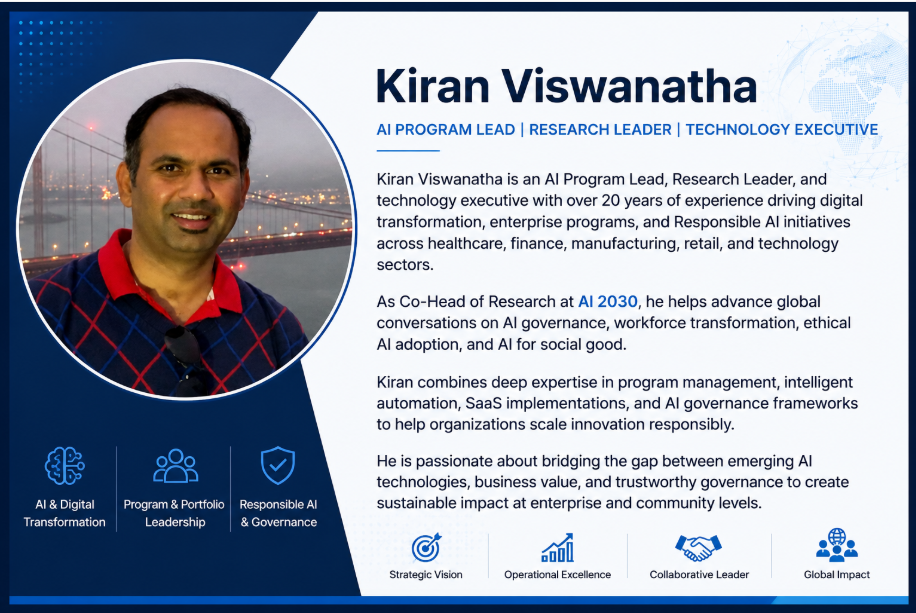
— Kiran Viswanatha