October 13 2026 at 02:09PM
Sailing into GenAI Waters: A Project Manager’s Guide to Risk, Scope, and Governance
Charting a course from experimentation to responsible AI delivery
Did you know?
Generative AI is changing the way organizations plan, build, operate, and deliver projects—but unlike a conventional technology implementation, a GenAI project can behave more like a moving ocean than a fixed construction site.
The technology evolves rapidly. Models change. Data can introduce unexpected behavior. AI-generated outputs may be inaccurate. Users discover new use cases after deployment. Regulatory expectations continue to evolve. And stakeholders may have very different ideas about what “AI success” actually means.
For project managers, this creates a new leadership challenge:
How do we keep the project on course when the technology, risks, and expectations are constantly moving?
The answer is not to avoid the water.
It is to learn how to navigate it.
⚓ Welcome Aboard: Why GenAI Is Different
Traditional projects often begin with relatively clear requirements, defined deliverables, known dependencies, and measurable acceptance criteria.
GenAI projects can be different.
A stakeholder might begin with:
“We want an AI chatbot.”
That sounds like a deliverable.
But the real project questions quickly become:
- Which users will interact with it?
- What business problem will it solve?
- What information can it access?
- Which data sources are trustworthy?
- What happens when it produces an incorrect answer?
- When should a human intervene?
- What information must never be exposed?
- How will we measure accuracy?
- How will we manage model changes?
- Who owns the AI after go-live?
- What happens when users discover new use cases?
Suddenly, the project is not simply “build a chatbot.”
It is a combination of technology, data, people, process, risk, governance, and change management.
PMI's current guidance reflects this evolution. Its 2026 global standard for AI in portfolio, program, and project management emphasizes strategic value, risk, governance and compliance, people and culture, ethics, stakeholder engagement, optimization, and data quality, alongside human-in-the-loop practices.
🧭 The First Rule of Navigation: Define the Destination
One of the biggest GenAI project risks is starting with the technology instead of the business outcome.
A project charter should not simply say:
“Implement Generative AI.”
Instead, define:
Business problem
What problem are we solving?
Target users
Who will benefit from the solution?
Value proposition
What measurable improvement are we expecting?
AI role
Will AI recommend, summarize, generate, classify, predict, or act?
Human role
Where must people review, approve, or override AI outputs?
Success criteria
How will we know the project actually worked?
For example:
Weak objective:
Implement an AI-powered employee assistant.
Stronger objective:
Reduce the average time employees spend searching approved HR knowledge from 15 minutes to less than 5 minutes while maintaining defined accuracy, privacy, escalation, and human-review controls.
The second objective gives the project manager something measurable.
It also gives governance something to govern.
🌊 Scope: Beware of the “AI Horizon”
GenAI projects can suffer from a unique form of scope creep.
A team starts with one use case.
Then someone asks:
“Can we also make it summarize meetings?”
Then:
“Can it write emails?”
Then:
“Can it analyze contracts?”
Then:
“Can we connect it to our ERP?”
Then:
“Can we allow it to take actions automatically?”
The project can quickly move from AI assistant → AI platform → AI agent → enterprise transformation.
This is where traditional scope management becomes critical.
Create an AI Scope Boundary
A useful GenAI scope statement should explicitly identify:
In scope
- Approved use cases
- Approved data sources
- Supported user groups
- Approved models
- Defined integrations
- Defined environments
- Defined automation level
Out of scope
- Autonomous decision-making
- Unapproved data
- Sensitive use cases
- Unvalidated external sources
- Unapproved integrations
- Self-modifying workflows
This is not about restricting innovation.
It is about creating a safe space in which innovation can occur.
🎯 Think in AI Use-Case Tiers
Project managers can also classify GenAI capabilities according to their potential impact.
🟢 Tier 1 — Assist
AI helps a person.
Examples:
- Meeting summaries
- Drafting
- Brainstorming
- Translation
- Knowledge search
Human accountability remains high.
🟡 Tier 2 — Recommend
AI analyzes information and recommends an action.
Examples:
- Project risk recommendations
- Resource optimization
- Customer-service recommendations
- Code suggestions
Human validation becomes particularly important.
🟠 Tier 3 — Execute with Approval
AI prepares an action and a person approves it.
Examples:
- Preparing purchase requests
- Drafting customer responses
- Creating change requests
- Preparing deployment actions
Controls, audit trails, and approval gates become essential.
🔴 Tier 4 — Autonomous Action
AI can initiate or execute actions with limited human intervention.
Examples:
- Autonomous workflow execution
- Agentic system interactions
- Automated operational decisions
This requires significantly stronger controls around permissions, monitoring, failure handling, security, and accountability.
The higher the autonomy, the stronger the governance should become.
🚨 Risk: Add an “AI Branch” to Your Risk Register
A conventional project risk register may contain:
- Schedule risk
- Budget risk
- Resource risk
- Vendor risk
- Technical risk
- Dependency risk
- Quality risk
GenAI introduces additional dimensions.
NIST's Generative AI Profile specifically identifies risks associated with GenAI and provides suggested actions to govern, map, measure, and manage those risks across the AI lifecycle.
For project managers, that means the risk register should not be a document created once during planning.
It should become a living navigation instrument.
🛟 The “Human-in-the-Loop” Lifeboat
One of the most important governance decisions in an AI project is determining:
Where does the human remain accountable?
Consider an AI system that summarizes a customer's complaint.
A human may simply verify the summary.
But consider an AI system recommending whether a customer should receive a financial benefit, medical intervention, employment opportunity, or other consequential decision.
The level of human oversight needs to be much stronger.
Project managers should define:
Human review required → Human approval required → Human override available → Escalation required
This should be reflected in the:
- Process design
- Requirements
- User stories
- Acceptance criteria
- SOPs
- RACI
- Testing strategy
- Training
- Incident management
Human oversight should not be an afterthought added just before go-live.
🔍 Quality Assurance for GenAI Is Different
Traditional software testing often asks:
Does the system produce the expected output?
GenAI testing needs to ask broader questions:
- Is the answer factually correct?
- Is the response consistent?
- Is the output safe?
- Does the model behave differently with adversarial prompts?
- Does it reveal confidential information?
- Does it treat user groups fairly?
- Does it appropriately express uncertainty?
- Does it know when to escalate?
- Does it remain within its authorized scope?
That means GenAI acceptance criteria should go beyond:
“The chatbot works.”
Consider:
“For the defined test set, the solution meets the agreed accuracy threshold, does not expose restricted information, appropriately escalates defined high-risk scenarios, and maintains required response-quality and safety thresholds.”
This turns responsible AI from a policy statement into a measurable project deliverable.
📚 A Real-World Lesson: When AI Sounds Confident but Is Wrong
One of the most widely discussed examples came from Mata v. Avianca in the U.S.
Attorneys submitted court filings containing nonexistent cases and citations generated by ChatGPT. The court found that the lawyers had failed in their responsibility to verify the AI-generated material and imposed sanctions.
The lesson for project managers is not simply:
“Don't use GenAI.”
It is:
AI output requires an accountable validation process.
If an AI-generated project status report contains an incorrect milestone, the PM remains accountable.
If AI generates a risk assessment containing fabricated evidence, the PM cannot simply say:
“The AI told me.”
Governance establishes the expectation that AI can assist the work, but accountability remains with people.
💡 A Different Lesson: AI Can Deliver Significant Value
Responsible governance should not become synonymous with saying “no.”
Consider Klarna's AI assistant.
In its 2025 annual report, Klarna reported that its AI assistant handled 80% of customer-service chats during 2025, while the company reported no decline in consumer satisfaction in its internal surveys. Klarna also reported that the assistant had reduced repeat inquiries and significantly shortened average resolution time.
The project-management lesson is important:
Responsible AI is not anti-automation.
The goal is to determine:
Where automation creates value → where controls are required → where humans remain essential.
Klarna also continued to offer customers human support, illustrating an important principle for AI-enabled service transformation: automation and human support can coexist.
🏛️ Governance Is Part of the Project—not a Gate at the End
One of the most common mistakes organizations can make is treating governance as a final approval checkpoint.
Imagine:
Build → Test → Deploy → Governance Review
By the time governance arrives, many architectural and business decisions are already locked in.
A better approach is:
Govern → Design → Build → Test → Deploy → Monitor → Improve
Governance questions should appear from the beginning:
Initiation
- What is the intended use?
- What is the risk level?
- Who owns the AI system?
Planning
- What data will be used?
- Which regulations apply?
- What controls are required?
Development
- How will outputs be evaluated?
- What security testing is required?
Deployment
- Who approves production release?
- What monitoring exists?
- What is the rollback strategy?
Operations
- How are incidents handled?
- How are model changes evaluated?
- When should the system be retrained, restricted, or retired?
This aligns closely with NIST's lifecycle-oriented approach to AI risk management and PMI's emphasis on integrating governance, risk management, and ethical safeguards into AI project delivery.
🌍 Regulation Is Becoming Part of the Project Landscape
Project managers should also recognize that AI governance is increasingly influenced by regulation.
As of August 2, 2026, major provisions of the EU AI Act are being enforced, including transparency requirements for certain AI systems. For example, applicable interactive AI systems must inform people when they are interacting with AI, and certain AI-generated or manipulated content must be appropriately marked.
This creates a practical project-management implication:
Regulatory requirements can become project requirements.
For globally deployed AI solutions, project teams may need to account for:
- AI transparency
- Data protection
- Human oversight
- Documentation
- Risk assessments
- Model governance
- Auditability
- Content labeling
- Incident management
The PM does not need to become the organization's lawyer or AI scientist.
But the PM does need to ensure that the right experts are involved at the right time.
🧭 The GenAI Project Compass
A practical way for project managers to navigate GenAI initiatives is to use five questions:
- VALUE
What business problem are we solving?
- SCOPE
What exactly will the AI do—and what will it not do?
- RISK
What could go wrong, and who could be affected?
- GOVERNANCE
Who makes decisions, approves exceptions, monitors performance, and owns accountability?
- OUTCOME
How will we measure whether the AI solution is successful?
If a project cannot answer these five questions, it may not be ready to sail.
📋 A GenAI PM Pre-Launch Checklist
Before launching an AI-enabled capability, ask:
☐ Is the business outcome clearly defined?
☐ Is the AI use case documented?
☐ Are in-scope and out-of-scope capabilities explicit?
☐ Has data been classified and approved?
☐ Have AI-specific risks been added to the risk register?
☐ Are hallucination and accuracy risks tested?
☐ Has cybersecurity testing been completed?
☐ Are privacy and IP considerations addressed?
☐ Is human oversight clearly defined?
☐ Are AI outputs traceable or auditable where required?
☐ Are stakeholders trained?
☐ Are escalation and incident-response processes established?
☐ Is there a rollback or shutdown strategy?
☐ Is post-launch monitoring defined?
☐ Is there an owner for the AI capability after the project closes?
That final question is particularly important.
Who owns the AI after the project manager leaves?
If nobody knows, the project is not truly ready for handover.
🚀 From Project Manager to AI Navigator
The role of the project manager is evolving.
We are moving from:
Schedule Manager → Delivery Leader → Transformation Leader → AI Navigator
The AI Navigator does not need to know every algorithm.
Instead, the PM must know how to bring together:
Business + Technology + Data + Security + Legal + Risk + Governance + People
That orchestration is where project leadership becomes especially valuable.
PMI's 2026 AI standard recognizes this shift by providing project professionals with a technology-agnostic foundation for applying AI across project, program, and portfolio work, including governance, risk, stakeholder engagement, data quality, and human oversight.
🌊 Final Thought: Keep the Compass, Even When the Ocean Changes
GenAI will continue to evolve.
Today's model may not be tomorrow's model.
Today's prompt may become tomorrow's agent.
Today's assistant may become tomorrow's autonomous workflow.
But some project-management principles remain remarkably stable:
Know the destination.
Understand the risks.
Control the scope.
Engage the right stakeholders.
Build quality into delivery.
Govern continuously.
Keep people accountable.
Measure outcomes—not just activity.
The most successful GenAI projects will not necessarily be the ones that deploy the most sophisticated models.
They will be the ones that successfully navigate the intersection of innovation, value, risk, people, and trust.
So, as project managers, perhaps the question is no longer:
“Are we ready for AI?”
Instead, ask:
“Are we ready to lead AI responsibly?”
Because the future of project management is not about standing safely on the shore watching AI sail past.
It is about learning to captain the ship.
Chart the course.
Manage the risk.
Govern the journey.
Deliver the value.
⚓ Sail smart. Govern responsibly. Deliver with confidence.
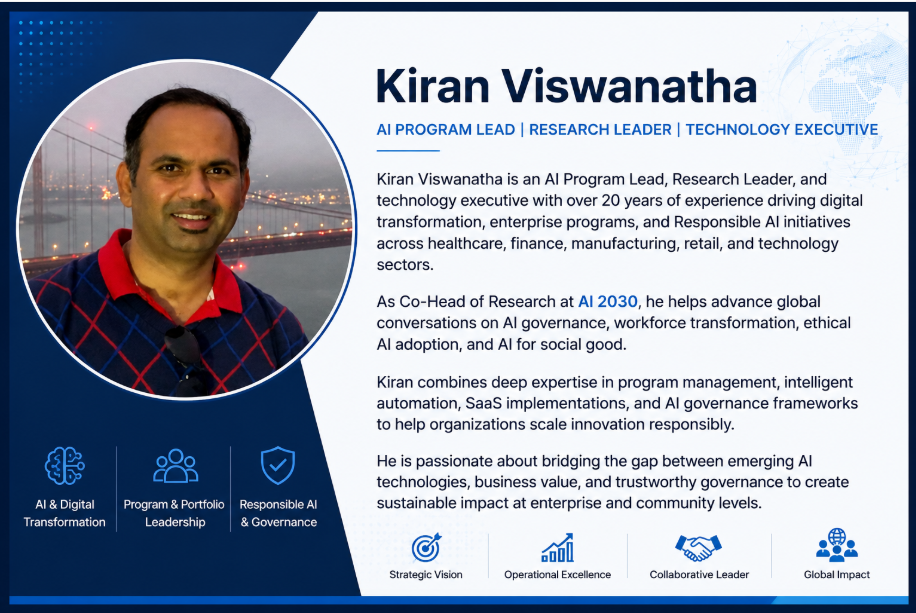
By Kiran Viswanatha