August 24 2026 at 09:40AM
The 5 Organizations Driving Florida’s Space Coast Economy
Florida’s Space Coast is often defined by one image: a rocket launching into orbit.
But the region’s economy is much larger than the launchpad.
Brevard County has developed an economic ecosystem built around aerospace, defense, healthcare, transportation, manufacturing, tourism, and advanced technology. The organizations operating within that ecosystem do more than employ residents—they create demand for contractors, suppliers, engineers, construction firms, restaurants, housing, transportation, professional services, and education.
From a project management perspective, the Space Coast is a fascinating case study in economic interdependency. A major aerospace expansion can create downstream opportunities for manufacturers. A port expansion can increase tourism and logistics activity. Healthcare growth can create demand for facilities, technology, construction, and specialized talent.
Here are five organizations that stand out as major economic engines for the Space Coast.
1. L3Harris Technologies — The Defense Technology Engine
L3Harris Technologies is one of the most important corporate anchors on the Space Coast.
The company is headquartered in Melbourne and operates across aerospace, defense, communications, space, cyber, and other mission-critical technologies. The Economic Development Commission of Florida’s Space Coast identifies L3Harris as the area's largest aerospace-industry employer.
Port Canaveral's 2025 principal-employer data lists L3Harris with approximately 7,600 employees in Brevard County, making it the county's third-largest employer overall.
Why it matters economically
L3Harris represents more than direct employment.
A large defense-technology organization generates demand for:
- Engineering
- Program management
- Manufacturing
- Software and cybersecurity
- Testing and validation
- Professional services
- Facilities
- Construction
- Contracting
- Specialized suppliers
- Education and workforce development
That creates a multiplier effect throughout the regional economy.
The PMP perspective
L3Harris demonstrates how portfolio management can become regional economic development.
One aerospace or defense program can contain hundreds of interconnected projects, suppliers, milestones, contracts, risks, and dependencies. When those projects expand, the economic benefits extend well beyond the company's own workforce.
Project-management lesson: A project should not be evaluated only by its internal deliverables. Its stakeholders and economic dependencies can extend throughout an entire ecosystem.
2. Northrop Grumman — Advanced Manufacturing & Aerospace
Northrop Grumman has established a significant presence on the Space Coast, particularly around Melbourne.
The company's Space Coast operations contribute to the region's aerospace, advanced manufacturing, defense, and engineering capabilities. Port Canaveral's 2025 data lists Northrop Grumman at approximately 5,000 Brevard County employees, making it the county's fourth-largest employer in that dataset.
The company's growth also illustrates the relationship between aerospace and advanced manufacturing.
The Space Coast Economic Development Commission reports that Brevard County manufacturing employment has increased 19% since 2001, compared with a 28% national decline over the same period.
Why it matters
Northrop Grumman helps reinforce the Space Coast's transition from an economy historically associated with launches into a broader high-technology manufacturing ecosystem.
That ecosystem requires:
Design → Engineering → Manufacturing → Testing → Integration → Launch → Sustainment
Every stage represents potential economic activity.
The PMP perspective
This is a classic example of a program ecosystem.
The rocket, aircraft, defense system, or spacecraft may be the visible deliverable. Behind it sits an enormous project network involving procurement, quality assurance, engineering, suppliers, regulatory requirements, testing, logistics, and risk management.
Project-management lesson: Complex projects create economic value because they coordinate multiple organizations toward a common strategic outcome.
3. Health First — The Healthcare Economic Engine
The Space Coast isn't powered exclusively by rockets.
Healthcare is one of Brevard County's largest employment sectors, and Health First is one of its most important organizations.
Port Canaveral's 2025 principal-employer data lists Health First Medical Group with approximately 9,500 employees, making it the second-largest employer in Brevard County behind the school system.
That is significant because healthcare creates a fundamentally different economic engine from aerospace.
Aerospace investment can be cyclical and heavily tied to government and commercial contracts.
Healthcare demand is comparatively persistent.
People require:
- Hospitals
- Physicians
- Nurses
- Medical technology
- Pharmaceuticals
- Diagnostic services
- Facilities
- Construction
- Information technology
- Insurance and administrative services
Why it matters
Healthcare helps diversify the Space Coast economy.
That diversification is important for economic resilience.
If aerospace experiences a temporary slowdown, healthcare does not simply disappear. If tourism changes, healthcare demand remains. If manufacturing contracts, residents still require medical services.
The PMP perspective
From a portfolio-management perspective, healthcare acts as an economic stabilizer.
The Space Coast's economy isn't one giant project. It is a portfolio of industries with different risk profiles.
Project-management lesson: Resilient portfolios balance high-growth opportunities with stable, recurring demand.
4. Port Canaveral — The Transportation, Tourism & Logistics Engine
Port Canaveral is another critical component of the Space Coast economy.
The port connects the region to cruise tourism, cargo transportation, logistics, government activity, and Central Florida's enormous visitor economy.
The Space Coast Economic Development Commission describes Port Canaveral as a gateway for shippers and highlights its cruise and cargo terminals, transportation connections, auto facilities, and logistics infrastructure.
This makes the port particularly interesting from a project-management perspective.
A port is essentially a large-scale infrastructure platform.
Its success depends on coordinating:
- Maritime operations
- Cruise lines
- Cargo operators
- Transportation networks
- Construction
- Warehousing
- Security
- Government agencies
- Tourism
- Local businesses
A major infrastructure project at the port therefore has the potential to affect hundreds of businesses.
The PMP perspective
Port Canaveral demonstrates the concept of stakeholder integration better than almost any organization in the region.
A port expansion isn't successful simply because construction is completed.
It must deliver value to passengers, shipping companies, businesses, governments, employees, transportation providers, and the surrounding community.
Project-management lesson: Infrastructure projects create value when physical assets are integrated into a larger operating ecosystem.
5. NASA & Kennedy Space Center — The Strategic Anchor
The fifth organization is different.
NASA is not a traditional private-sector business, but it may be impossible to understand the Space Coast economy without discussing NASA's Kennedy Space Center (KSP).
KSP created the infrastructure, workforce, knowledge base, supplier ecosystem, and global identity that allowed the region's modern commercial space economy to develop.
NASA's own economic-impact analysis found that KSP's FY2021 workforce of 12,312 employees generated approximately 27,004 additional Florida jobs through secondary spending by workers and suppliers. The center generated approximately $2.89 billion in direct sales activity and ultimately contributed an estimated $2.77 billion in total GDP impact to Florida's economy.
That is the definition of an economic anchor.
And the ecosystem has continued evolving.
KSP is now a multi-user spaceport with government and commercial participants. NASA reported more than 90 private-sector partners and nearly 250 partnership agreements in its economic-impact analysis.
The PMP perspective
KSP is effectively the program office at the center of the Space Coast's largest strategic program: becoming a global space hub.
NASA provides infrastructure, expertise, research, partnerships, standards, and a platform upon which commercial companies can build.
That has helped attract organizations including SpaceX, Blue Origin, Boeing, Lockheed Martin and other aerospace companies to the region.
Project-management lesson: Strategic programs can create value far beyond their original scope when they establish platforms that allow other organizations to innovate.
The Bigger Picture: The Space Coast Is a Portfolio
The most important takeaway isn't which organization ranks first.
It is how they interact.
Consider the ecosystem:
NASA / Kennedy Space Center
↓
Commercial Space & Defense
↓
L3Harris / Northrop Grumman / Lockheed Martin / SpaceX / Blue Origin
↓
Manufacturers & Suppliers
↓
Engineering / Construction / Professional Services
↓
Workers & Households
↓
Housing / Retail / Restaurants / Healthcare / Education
↓
Regional Economic Growth
Meanwhile:
Port Canaveral
↓
Cruise & Cargo Activity
↓
Tourism / Transportation / Hospitality
↓
Local Business Revenue & Employment
And:
Health First & Healthcare Providers
↓
Healthcare Employment & Services
↓
Stable Household Income & Regional Demand
This is why the Space Coast should not be viewed simply as "where rockets launch."
It is a diversified economic portfolio anchored by aerospace and supported by healthcare, manufacturing, logistics, tourism, education and technology.
What Project Managers Can Learn From the Space Coast
The Space Coast offers a real-world example of several core PMP principles.
1. Projects create ecosystems
A $600 million aerospace investment isn't simply a construction project.
For example, Florida announced in 2026 that Blue Origin would invest $600 million in a Rocket Park manufacturing expansion expected to create 500 aerospace jobs.
The project creates secondary requirements for suppliers, construction workers, engineers, transportation, housing, restaurants and professional services.
2. Dependencies matter
No aerospace company operates in isolation.
A launch requires infrastructure, suppliers, engineers, government agencies, transportation, manufacturing, testing, communications and a workforce.
Understanding those dependencies is fundamental to successful program management.
3. Stakeholders determine project value
The Space Coast has thousands of stakeholders.
Government.
Businesses.
Employees.
Residents.
Tourists.
Suppliers.
Educational institutions.
Investors.
Communities.
A technically successful project can still fail to deliver its intended economic value if stakeholder needs aren't addressed.
4. Infrastructure creates optionality
Kennedy Space Center and Port Canaveral demonstrate an important strategic principle:
Infrastructure creates future opportunities.
Once the infrastructure exists, new companies can use it.
New programs can be launched.
New suppliers can establish operations.
New workers can move into the region.
New businesses can form around the ecosystem.
That is how economic development compounds.
Final Thought
The Space Coast's greatest economic asset isn't any single company.
It is the network connecting them.
NASA helped establish the foundation.
Aerospace and defense companies expanded the industrial base.
Manufacturers and suppliers created depth.
Port Canaveral connected the region to global transportation and tourism.
Healthcare provided stability.
Together, these organizations form a regional economic portfolio capable of supporting innovation, employment, investment and long-term growth.
For project managers, the lesson is powerful:
The biggest projects aren't always the ones with the largest budgets. Sometimes they're the projects that create ecosystems capable of producing thousands of projects afterward.
And that may be the Space Coast's most important project of all: turning a history of space exploration into a sustainable economic future.
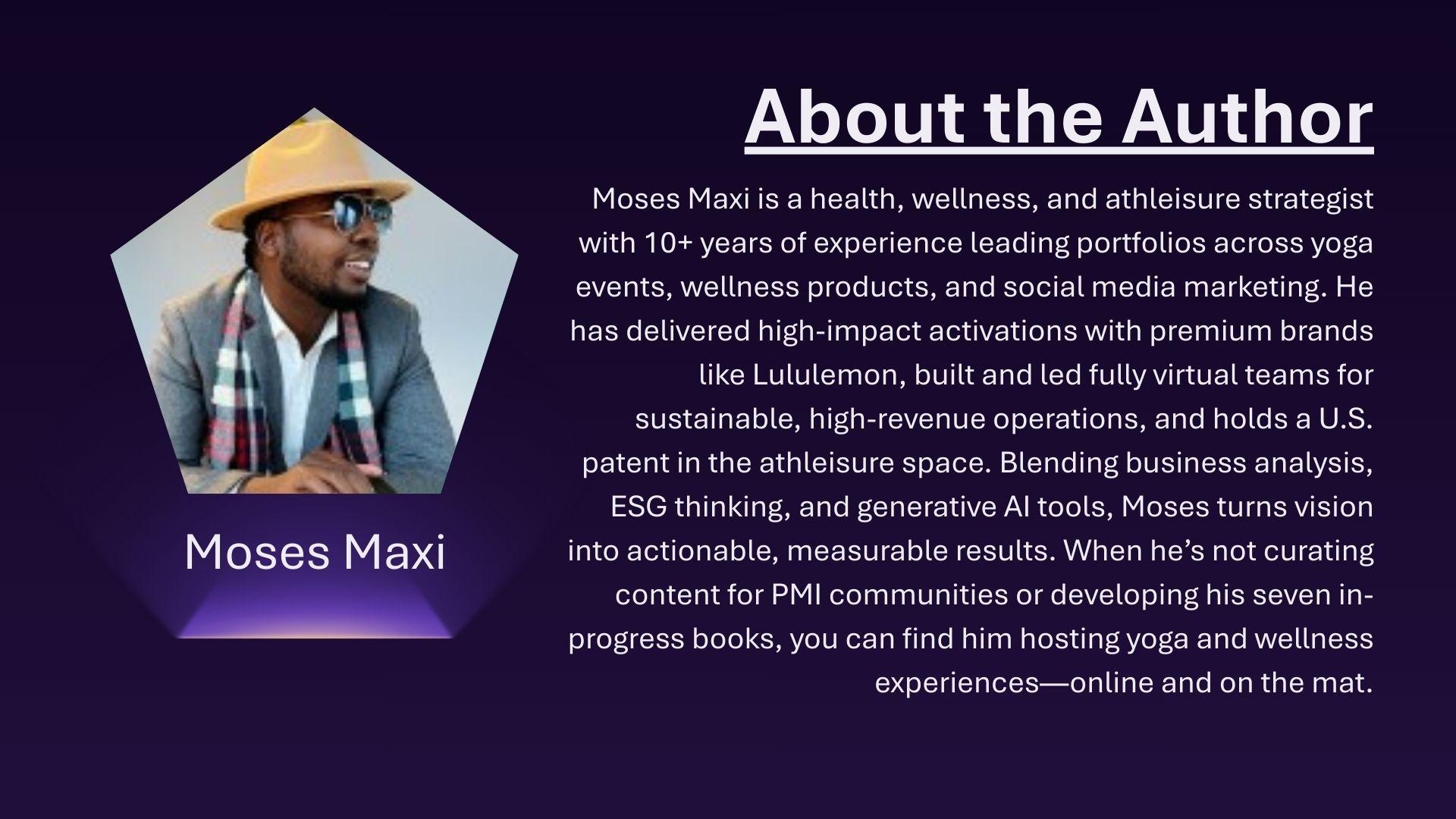
By Moses Maxi, PMP
Project Management, Economic Development & Strategic Growth, Chief Capital Assets & Creation Officer