October 26 2026 at 10:01AM
The AI Leadership Challenge Balancing Computing Power, Water Conservation, Energy Efficiency, and Responsible
Did You Know? Can Data Centres Use Air Cooling Instead of Water-Based Cooling?
The AI Leadership Challenge: Balancing Computing Power, Water Conservation, Energy Efficiency, and Responsible Growth
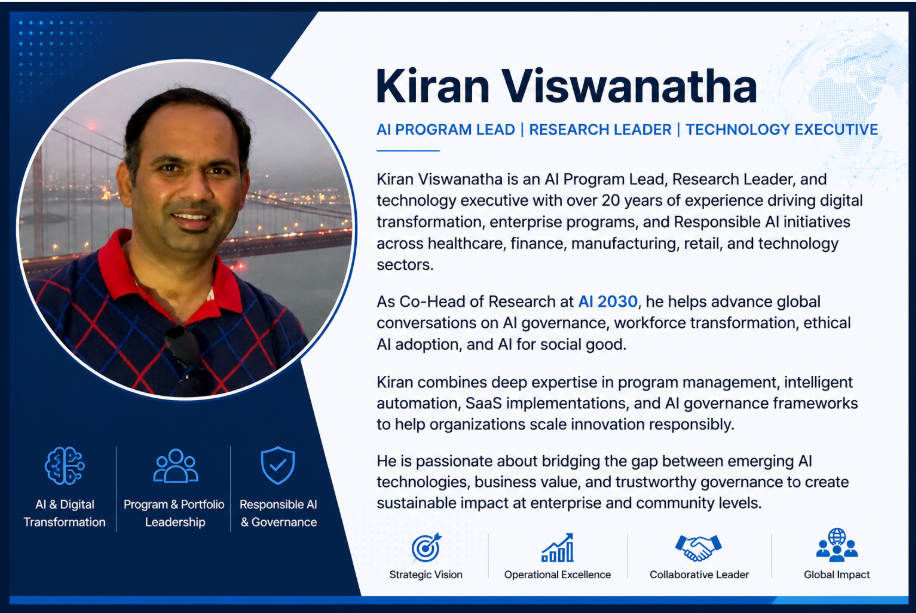
By Kiran Viswanatha
Did you know that a data centre can potentially eliminate water evaporation for cooling without compromising its ability to support digital services? As artificial intelligence accelerates demand for computing power, organizations are rethinking one of the most fundamental aspects of digital infrastructure: how to keep the machines that power AI from overheating.
From generative AI assistants and enterprise copilots to autonomous AI agents and large language models, every digital interaction requires computing resources—and those resources generate heat. Traditionally, data centres have used combinations of air conditioning, chilled water, and evaporative cooling to manage that heat. But as water scarcity becomes a growing concern and AI workloads become more demanding, an important question emerges:
Can air cooling replace water-based cooling in data centres—and should AI leaders make it a priority?
The answer is yes in some environments, but not universally. The most responsible strategy is to match the cooling architecture to the computing workload, local climate, water availability, energy costs, and long-term business objectives.
- Why should AI leaders care about data centre cooling?
AI infrastructure is no longer just an IT investment. It is a strategic business decision with implications for sustainability, operational resilience, community relationships, capital expenditure, and organizational reputation.
Data centres consume electricity to power servers, networking equipment, storage, and cooling systems. The more powerful the computing hardware, the more heat must be removed to keep equipment within its operating limits.
Water-based cooling can be energy-efficient because water transfers heat more effectively than air. However, evaporative cooling systems consume water, potentially competing with the needs of local communities, agriculture, and ecosystems.
Air-based cooling and dry heat-rejection systems can reduce or eliminate water evaporation for cooling, but they may require more electricity under certain conditions. The trade-off depends on the design, climate, operating temperatures, and workload.
Google, for example, explains that its cooling decisions consider the local environment and balance water stewardship against energy and carbon impacts. Its approach demonstrates that there is no single cooling strategy that is best for every location. Google Data Centers: Responsible water use.
For leadership teams, the lesson is clear: cooling should be part of AI investment strategy, not an infrastructure decision made after the computing requirements are finalized.
- How does air cooling work?
Air cooling removes heat by moving air across or through servers, collecting the warmed air, and transferring that heat outside the facility. Fans, air-handling equipment, heat exchangers, and refrigeration systems may all play a role.
There are several ways to implement it:
- Conventional air conditioning: Computer room air conditioners or air handlers cool and circulate air through the data centre.
- Hot-aisle and cold-aisle containment: Server racks are arranged to separate hot exhaust air from cold supply air, preventing unnecessary mixing.
- Air-side economization: When outdoor conditions are suitable, outside air can help cool the facility and reduce the use of mechanical refrigeration.
- Dry coolers: Heat is transferred to outdoor air through heat exchangers, reducing or eliminating the need for evaporative cooling.
The US Department of Energy highlights air-side economization as an opportunity to reduce cooling energy and water use, particularly when outdoor temperatures and air quality are favorable. Its effectiveness depends on climate, humidity, contamination controls, and equipment requirements. US Department of Energy: Cooling water efficiency opportunities.
Air cooling is therefore not a new or experimental concept. The challenge is determining where it remains practical as server power densities increase.
One important distinction is often overlooked: using liquid to carry heat does not necessarily mean consuming large amounts of water. A closed-loop system can circulate liquid repeatedly, while a dry cooler rejects heat to the atmosphere without relying on cooling-tower evaporation. The type of cooling fluid, system configuration, and heat-rejection method all matter.
- Real-world examples: What are industry leaders doing?
Example 1: Microsoft’s zero-water-evaporation data centre design
In December 2024, Microsoft announced a next-generation data centre design that uses chip-level cooling in a closed-loop system to avoid evaporative water consumption for cooling. The company estimated that the design could avoid the need for more than 125 million litres of water per data centre per year, based on its stated assumptions.
The approach is designed to deliver precise temperature control while circulating cooling liquid through a closed loop. Microsoft also acknowledged an important trade-off: moving away from evaporative cooling can increase energy use, although its design uses higher-temperature cooling to help mitigate that impact.
Microsoft stated that new designs began adopting this approach in August 2024, with initial sites expected to come online from late 2027. This is a deployment roadmap, not evidence that its entire existing fleet already operates without evaporative cooling.
Leadership takeaway: Water conservation can be engineered into infrastructure from the design stage. However, business cases must evaluate electricity consumption alongside water savings.
Source: Microsoft — Sustainable by design: Next-generation datacenters consume zero water for cooling.
Example 2: Google’s location-sensitive cooling decisions
Google has explained that water-based cooling can reduce energy consumption and related carbon emissions compared with air-based alternatives in some locations. At the same time, it considers alternatives such as air cooling or recycled water where local water risks are high.
This illustrates a key principle of responsible infrastructure planning: the best solution depends on local conditions. A design optimized for a cool region with abundant water may not be appropriate for a drought-prone region with limited water supplies.
Leadership takeaway: Data centre location, cooling design, energy sourcing, and water stewardship should be evaluated together—not as separate procurement decisions.
Source: Google Data Centers — Advancing responsible water use.
Example 3: Google’s Brazos system—combining air-cooled facilities with liquid-cooled AI hardware
In June 2026, Google introduced Brazos, a rack-mounted, closed-loop liquid-to-air cooling system designed to support high-density AI and high-performance computing equipment in existing air-cooled data centre environments.
Google explained that next-generation AI chips can exceed 1,000 watts of thermal design power, creating heat loads that standard air cooling cannot manage effectively on its own. Brazos aims to support higher-density equipment without requiring an entire facility to be retrofitted with chilled-water infrastructure.
This is a particularly relevant example because it demonstrates that the choice does not have to be “air everywhere” or “water everywhere.” Liquid can remove heat from the chip, while air can help carry that heat away at the rack or facility level.
Leadership takeaway: Hybrid cooling can provide a migration path for organizations that need to expand AI capacity without replacing every component of their existing infrastructure.
Source: Google Cloud — Introducing Brazos: Bringing liquid cooling to air-cooled data centers.
- The AI-era challenge: Can air cooling handle high-density GPU racks?
For traditional enterprise workloads, air cooling can remain a practical and efficient choice when airflow, temperature, and equipment density are properly managed.
AI training and inference workloads are different. High-performance GPUs concentrate substantial electrical power and heat into relatively small rack footprints. At these densities, moving enough air through the equipment can become difficult, noisy, energy-intensive, or physically impractical.
ASHRAE's AI data centre guidance describes liquid cooling as an important solution for high-density deployments, including racks in the 50–100 kW range and above. Actual requirements vary by server design and manufacturer specifications. ASHRAE — Energy and thermal efficiency.
This does not mean air cooling is obsolete. It means leaders should distinguish between two questions:
- How is heat removed from the chips and servers? Air, direct-to-chip liquid, rear-door heat exchangers, and immersion systems are possible approaches.
- How is heat rejected from the facility to the environment? Options include evaporative cooling towers, dry coolers, and other heat-rejection systems.
A data centre can use liquid cooling at the chip level and still use air-based, water-free heat rejection. This distinction is critical when evaluating water-saving claims.
For many AI facilities, a hybrid architecture may be the most practical option: direct-to-chip liquid cooling for high-density GPU racks, with conventional air cooling for networking equipment, storage, and lower-density workloads.
- What should project managers and AI leadership teams do?
Cooling decisions have a direct impact on project scope, budget, schedule, risk, sustainability commitments, and the ability to scale AI responsibly.
Here is a practical approach for project and programme leaders.
Step 1 — Establish the baseline. Document the expected computing load, rack density, climate conditions, cooling energy, water consumption, redundancy requirements, and future AI capacity.
Step 2 — Compare complete-system designs. Evaluate conventional air cooling, air cooling with dry heat rejection, liquid cooling with dry coolers, and hybrid approaches. Include capital costs, electricity, water, maintenance, downtime, and equipment compatibility.
Step 3 — Use measurable sustainability metrics. Track Power Usage Effectiveness (PUE), Water Usage Effectiveness (WUE), cooling energy, and total facility water consumption. Assess local water stress as well as total volume. No single metric tells the complete story.
Step 4 — Pilot before scaling. Test the proposed solution against representative workloads and seasonal conditions. Measure server inlet temperatures, cooling energy, water use, reliability, maintenance requirements, and performance under peak demand.
Step 5 — Embed governance and accountability. Assign clear ownership across facilities, IT, sustainability, procurement, finance, and AI leadership. Establish design approval criteria, operational thresholds, monitoring, escalation procedures, and evidence for sustainability claims.
Step 6 — Design for change. AI hardware evolves quickly. Plan for increasing rack density, modular cooling capacity, maintainability, future liquid-cooling adoption, and opportunities to reuse waste heat where practical.
A project should not be considered successful simply because the data centre has reduced water use. It must also deliver reliable computing, acceptable energy consumption, operational resilience, and sustainable total cost of ownership.
- A practical leadership scenario
Imagine an organization planning a new AI platform to support customer service, document processing, and enterprise copilots.
The initial proposal uses conventional air cooling because the team is familiar with it and the upfront cost appears lower. During design review, the infrastructure team forecasts that future GPU deployments may substantially increase rack density. Meanwhile, the sustainability team identifies local water availability as a strategic concern.
Instead of treating this as a conflict between IT and sustainability, the programme manager brings together facilities engineering, AI infrastructure, finance, procurement, and sustainability leaders.
The team compares three options:
- Conventional air cooling with optimized airflow and containment.
- Air cooling combined with dry heat rejection, where technically suitable.
- A hybrid design using direct-to-chip liquid cooling for dense GPU racks and air cooling for other equipment.
The team evaluates each option against five decision criteria: lifecycle cost, energy consumption, water consumption, performance, and scalability.
A pilot validates the preferred architecture before full deployment. The final decision is documented with assumptions, measured results, operational risks, and a plan for future capacity expansion.
This is responsible AI leadership in practice: sustainability is built into the architecture and project governance rather than added as a reporting exercise after implementation.
- The business case: Water savings are not the only measure of success
Air-based or dry cooling can reduce water consumption, but it should not automatically be assumed to be cheaper, greener, or more efficient.
A design that eliminates cooling-tower evaporation may increase electricity consumption. Depending on the local grid, that additional electricity may increase carbon emissions. Conversely, liquid cooling combined with suitable dry heat rejection may reduce water use while supporting high-density AI workloads.
Leadership teams should therefore assess the combined impact of:
- Water: How much water is withdrawn and consumed, and what is the local watershed risk?
- Energy: How much electricity is required by the servers and cooling equipment?
- Carbon: What emissions result from the facility's total energy use?
- Cost: What are the capital, operating, maintenance, and replacement costs over the system's life?
- Resilience: Can the facility sustain operation during heatwaves, water restrictions, equipment failures, and changing workloads?
- Scalability: Will the cooling design support the organization's future AI roadmap without expensive redesign?
The objective is not to optimize one environmental metric at the expense of all others. It is to choose a solution that performs responsibly across the full system.
For organizations that already operate data centres, the first step may simply be to improve airflow management, containment, temperature settings, and cooling controls. More extensive changes should follow a technical assessment rather than a blanket commitment to replace existing systems.
Final thought: Responsible AI starts before the first prompt
The future of AI depends not only on smarter models, better data, and responsible algorithms, but also on the physical infrastructure that enables them to operate.
Air cooling can be a valuable part of a water-conscious data centre strategy. Yet the most effective answer is often not to eliminate water-based technologies entirely, but to use water, air, and liquid cooling intelligently—according to the workload, location, and environmental constraints.
For AI leaders and project managers, the opportunity is to make cooling a deliberate part of responsible technology governance: measured, evidence-based, transparent, and aligned with long-term business and community needs.
The goal is not simply to cool AI infrastructure. It is to power AI responsibly—without wasting the energy, water, or trust that future innovation depends on.