
October 20 2026 at 03:44PM
The Leadership Equation for the AI Era: Remember Intelligently. Act Responsibly. Lead Intentionally.
Did you know? The biggest risk of AI leadership may not be what AI cannot do—but what we allow it to remember, decide, and execute without sufficient human judgment.
Imagine an executive preparing for a critical program review. The AI assistant has summarized the latest reports, retrieved previous decisions, identified overdue actions, and recommended ways to address emerging risks. Everything appears organized and ready.
But what if the assistant retrieved an outdated decision? What if it treated an unverified assumption as a fact? What if it automatically sent a sensitive message or changed a project commitment without approval?
The same capability that makes AI powerful can also amplify mistakes when memory, authority, and accountability are poorly designed.
This is why the future of AI leadership needs a different mindset. Success is not about making AI remember everything, do everything, or decide everything. It is about using AI to strengthen human capabilities while keeping responsibility where it belongs.
These three principles provide a practical leadership philosophy for organizations moving from AI experimentation toward AI-enabled operations.
- Remember intelligently: Preserve what matters, not everything that exists
Organizations generate enormous amounts of information, yet leaders still struggle to find the context needed to make timely decisions.
A project manager may have the latest status in a dashboard, the rationale for a scope change in meeting minutes, an unresolved dependency in an email, and an executive commitment in a separate action tracker.
The problem is not necessarily a lack of data. It is the lack of connected, reliable, and accessible knowledge.
AI assistants with persistent memory and access to approved enterprise information can help bridge that gap. They can retrieve previous decisions, connect project dependencies, identify unresolved commitments, and prepare briefings tailored to a particular leadership meeting.
But intelligent memory requires judgment about what should be retained.
A responsible AI system should distinguish between:
- Facts: Information verified against an authoritative source.
- Decisions: Approved outcomes, their rationale, and the people responsible.
- Commitments: Actions, owners, deadlines, and dependencies.
- Assumptions: Beliefs or expectations that still require validation.
- Historical context: Information that may explain a previous decision but may no longer be current.
Consider a transformation program in which the security team has not approved an integration. A vendor dependency is also delayed, and the release milestone is approaching.
An AI assistant could retrieve the latest project records, connect the dependencies, and flag a potential schedule risk. The project manager could then validate the situation with the relevant owners and decide whether to escalate.
The benefit is not that AI remembers every conversation. It is that AI helps leaders recover the right context at the right time.
The leadership lesson
Memory should be treated as a governed organizational capability, not an unlimited digital archive.
Leaders must establish what information the AI can access, what it can retain, how long it should retain it, how inaccuracies can be corrected, and how sensitive information is protected.
The objective is to create continuity without allowing outdated information, unsupported assumptions, or unnecessary personal data to influence future decisions.
- Act responsibly: Give AI authority in proportion to risk
AI is evolving from a tool that generates responses into systems that can use tools, initiate workflows, and take actions across business applications.
This creates an essential governance question: What should an AI system be allowed to do without human approval?
Imagine an AI project assistant that detects a delayed milestone. It prepares a revised schedule, drafts an escalation email, and recommends moving resources from another workstream.
These are potentially valuable contributions. However, sending the email, changing the approved project baseline, or reallocating a budget may require human authorization.
A practical leadership model separates AI activity into three levels:
Recommend: Analyze information, identify risks, and suggest options.
Prepare: Draft communications, assemble reports, and propose changes for review.
Execute: Update systems, send communications, or perform other authorized actions under defined controls.
The appropriate level depends on the consequences, reversibility, and risk of the action. Routine, low-risk activities may be suitable for automation, while sensitive or high-impact decisions need stronger oversight.
A real-world lesson: Efficiency without fairness is not success
In 2018, Amazon abandoned an experimental AI recruiting tool after discovering that it penalized certain résumés associated with women. The system had learned patterns from historical hiring data that reflected existing gender imbalances. The case demonstrated how automation can reproduce historical bias rather than eliminate it. Read the Reuters report published by The Guardian.
For leadership teams, the lesson extends beyond recruitment. AI recommendations can influence project prioritization, resource allocation, vendor evaluation, and workforce planning.
A system may appear efficient while producing unreliable or unfair outcomes. Leaders must therefore ensure that people can question AI recommendations, examine relevant evidence, and intervene when necessary.
The NIST AI Risk Management Framework provides a useful foundation for integrating trustworthiness and risk management throughout the AI lifecycle.
The leadership lesson
Autonomy should be earned through evidence, testing, and clearly defined controls—not granted simply because the technology can act.
Responsible action requires explicit permissions, traceable decisions, appropriate human approval, and a clear owner accountable for the system's performance.
- Lead intentionally: Use AI to improve human judgment
Leadership is not a contest to process the largest volume of information or make decisions at the highest speed.
It involves understanding competing priorities, navigating uncertainty, building trust, resolving conflict, and accepting responsibility for outcomes.
AI can reduce the administrative work surrounding these activities, allowing leaders to direct more attention toward the work that requires human judgment.
For project managers, this could mean less time chasing status updates and more time managing stakeholder expectations.
For program directors, it could mean earlier visibility into dependencies that span multiple projects.
For executive teams, it could mean more productive steering committees focused on strategic trade-offs rather than reconstructing past discussions.
For Responsible AI leaders, it could mean moving beyond policy statements to assess whether governance controls are effective in day-to-day operations.
An illustrative project scenario
Imagine a program office preparing for a major enterprise release. An AI assistant consolidates information from approved project records and prepares a briefing that identifies:
- A critical milestone that may be delayed.
- Two unresolved decisions requiring executive attention.
- A dependency affecting multiple workstreams.
- The evidence supporting each concern.
- Recommended questions for the steering committee.
The assistant does not independently declare the project a failure or change the delivery plan. Instead, it presents the evidence and identifies the decisions that require leadership attention.
The program director validates the information, discusses trade-offs with the team, and determines the appropriate course of action.
In this scenario, AI improves the quality of the decision-making process without replacing the people accountable for the result.
That is intentional leadership: using AI to make human judgment better informed, not less necessary.
- Connect the three principles through Responsible AI governance
Remembering intelligently, acting responsibly, and leading intentionally should not be separate aspirations. They should operate as one connected governance model.
Consider this sequence:
Purpose → Memory → Evidence → Decision → Action → Accountability → Improvement
- Purpose: Define the business objective and intended benefit.
- Memory: Retain only relevant information under clear rules.
- Evidence: Validate important claims against reliable sources.
- Decision: Determine what the AI may recommend or prepare, and what requires human judgment.
- Action: Apply appropriate permissions, approval gates, and safeguards.
- Accountability: Identify who owns the system and its outcomes.
- Improvement: Monitor performance, learn from incidents, and revise controls.
This approach aligns with the NIST AI Risk Management Framework's four core functions: Govern, Map, Measure, and Manage. The framework emphasizes that AI risk management should be integrated throughout the system lifecycle, rather than treated as a one-time compliance exercise. Explore the NIST AI RMF Core.
For leadership teams, this means governance must be reflected in architecture, operating procedures, responsibilities, monitoring, and evidence—not simply in an AI policy document.
A practical governance review should ask:
- Is the information being used current, authorized, and relevant?
- Can consequential recommendations be traced to supporting evidence?
- Are the AI system's permissions proportionate to its responsibilities?
- Can a human challenge, stop, or reverse an action when appropriate?
- Is a named person or team accountable for outcomes and corrective action?
These questions make Responsible AI operational.
- How project managers can put the principle into practice
Project managers are well positioned to turn these principles into everyday delivery practices because they already work with scope, risk, accountability, dependencies, and governance.
Here is a practical 30-day approach.
Week 1: Identify what matters
Choose one recurring workflow, such as project status reporting, action tracking, or steering committee preparation.
Identify the information needed, the authoritative sources, the decisions being supported, and the consequences of an error.
Week 2: Establish trusted memory
Define what the assistant can access and retain. Create clear records of decisions, risks, actions, owners, and due dates.
Ensure the assistant can distinguish verified facts from assumptions and identify conflicting or outdated information.
Week 3: Introduce controlled action
Use AI to prepare briefings, identify potential dependencies, draft communications, and recommend next steps.
Keep consequential actions behind appropriate approval gates. Test the assistant with incomplete records, conflicting information, and outdated decisions.
Week 4: Measure value and responsibility
Evaluate both productivity and governance outcomes.
Establish a baseline before the pilot so the team can determine whether the AI assistant actually improves performance.
The goal is not to demonstrate that AI can perform more tasks. It is to show that AI can help the organization deliver better outcomes responsibly.
- What executive leaders must do differently
Responsible AI leadership begins with a shift in how success is defined.
Instead of asking only, “How much work can we automate?” leaders should ask, “Which human capabilities can we strengthen, which risks must we control, and which outcomes will demonstrate value?”
This shift has several implications:
For strategy: Prioritize AI use cases based on business value, stakeholder impact, and risk—not novelty alone.
For governance: Define decision rights, access boundaries, approval requirements, and accountability before expanding autonomy.
For culture: Encourage employees to question AI outputs, report failures, and challenge recommendations without treating automation as inherently authoritative.
For performance: Measure trustworthiness, decision quality, and real-world outcomes alongside cost savings and productivity.
For people: Invest in AI literacy, critical thinking, domain expertise, and the ability to supervise automated systems effectively.
Human oversight must also be meaningful. Assigning a person to approve an AI recommendation is not enough if that person lacks the evidence, authority, time, or expertise to challenge it.
Leaders must create the conditions in which people can exercise genuine judgment.
- The future belongs to leaders who know when not to automate
As AI systems become more capable, the temptation will be to delegate increasingly complex tasks and decisions.
But capability does not automatically establish appropriateness. An AI system may be able to generate a recommendation without having enough reliable context to make it trustworthy. It may be able to execute an action without understanding all the organizational consequences.
Mature AI leadership recognizes these distinctions.
Sometimes the right decision is to automate. Sometimes it is to ask for human confirmation. Sometimes it is to gather more evidence. And sometimes it is to stop.
These are not signs of technological hesitation. They are signs of responsible judgment.
The strongest organizations will be those that know what to delegate, what to verify, what to protect, and what must remain under accountable human control.
A leadership call to action
At your next AI steering committee or project governance meeting, ask three questions:
- Remember intelligently: Are we preserving the right knowledge while protecting privacy and preventing outdated information from misleading future decisions?
- Act responsibly: Have we defined what AI can recommend, prepare, and execute—and who must authorize consequential actions?
- Lead intentionally: Are we using AI to strengthen human judgment, collaboration, and outcomes, or simply increasing the volume and speed of automation?
Choose one workflow, assign an accountable owner, define measurable outcomes, and test the governance controls before scaling.
The purpose of AI leadership is not to build systems that operate without people. It is to build systems that help people make better decisions, act with greater confidence, and deliver value without losing sight of their responsibilities.
Remember intelligently. Act responsibly. Lead intentionally.
Because the true measure of AI maturity is not how much an organization can delegate to machines. It is how effectively the organization combines intelligent technology, human judgment, and accountable governance to create lasting value.
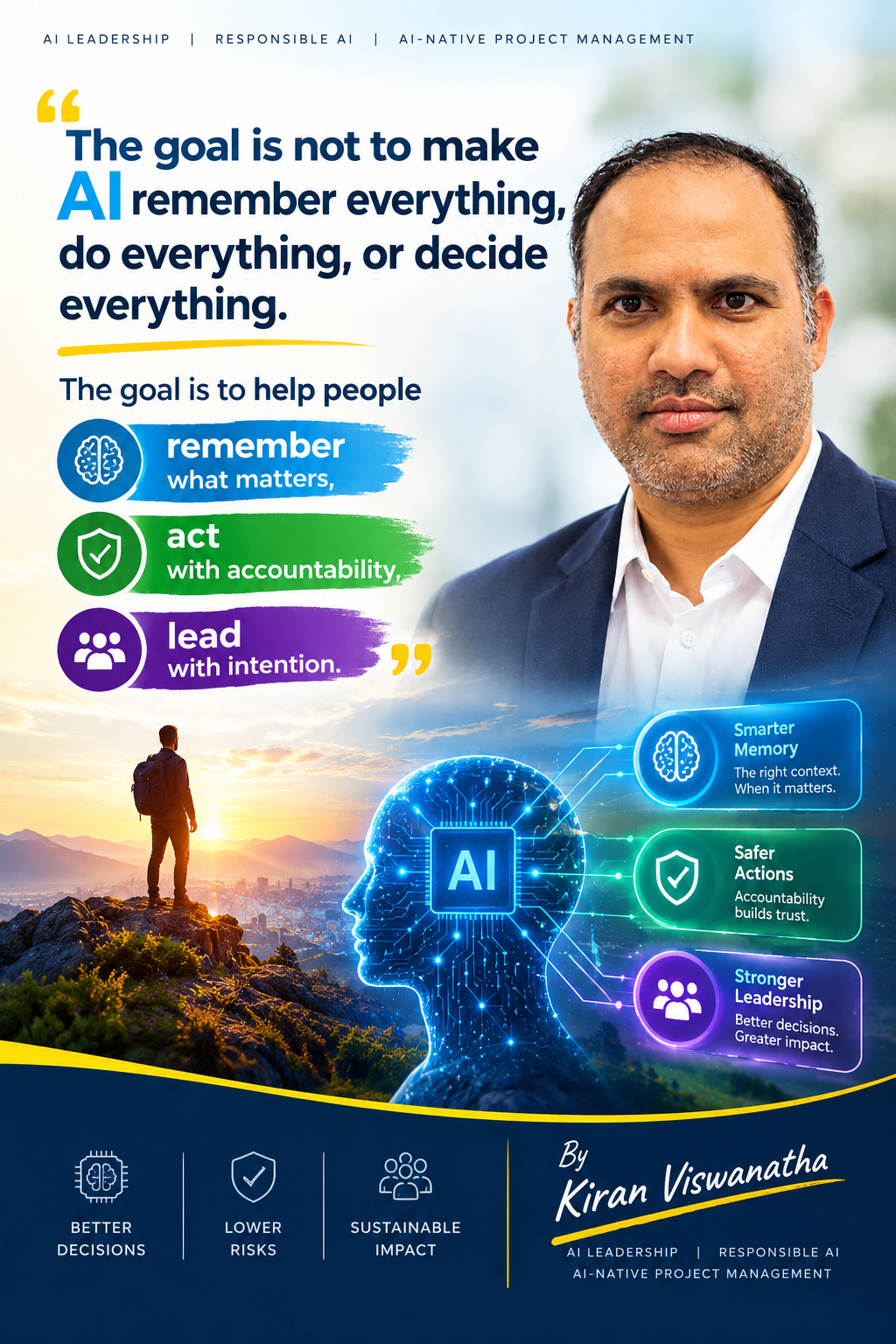
“The goal is not to make AI remember everything, do everything, or decide everything. The goal is to help people remember what matters, act with accountability, and lead with intention.”
Follow our News