May 18 2026 at 12:00PM
The Observer Effect in AI: From Infinite Potential to Real-World Impact
Why what we measure, monitor, and govern shapes the AI we get
Did you know that the act of observing a system can change its behavior? In physics, this is known as the Observer Effect—and it has a powerful parallel in how AI systems behave in the real world.
In the AI era, especially with Large Language Models and autonomous systems, the transition from infinite potential to real-world outcomes is not just about algorithms. It’s about what we observe, how we measure, and what we choose to govern.
For AI leaders and project managers, this is not philosophical—it’s operational.
From Infinite Potential to Defined Reality
AI systems, particularly generative models, begin with broad, open-ended capability:
- They can generate countless responses
- Adapt across domains
- Operate with probabilistic reasoning
But once deployed, their behavior becomes constrained by observation and governance:
- Metrics define success
- Guardrails define boundaries
- Monitoring defines acceptable behavior
👉 In essence:
The AI you observe, measure, and control is the AI you ultimately create.
The Observer Effect in AI Implementation
- Metrics ShapeBehavior
AI systems are optimized for what we measure.
Example:
- If you optimize for accuracy only, you may ignore fairness or explainability
- If you optimize for engagement, you may unintentionally amplify bias or sensational outputs
👉 Outcome: AI behavior aligns with measurement priorities, not necessarily business or ethical goals.
- Monitoring Changes System Dynamics
When systems are monitored:
- Anomalies are detected faster
- Risky behaviors are corrected
- Feedback loops influence future outputs
Real-world pattern:
Organizations that implement real-time monitoring often see immediate shifts in model outputs due to continuous feedback and tuning.
- Governance Defines Reality Boundaries
Governance frameworks determine:
- What AI is allowed to do
- What it must avoid
- When human intervention is required
👉 Without governance:
AI remains in a state of unbounded potential (and risk)
👉 With governance:
AI operates within trusted, predictable boundaries
Why This Matters for AI Leadership
The Observer Effect highlights a critical leadership insight:
AI systems don’t just evolve from data—they evolve from the structures we place around them.
This means:
- Poor measurement → Misaligned outcomes
- Weak monitoring → Undetected risks
- Superficial governance → Uncontrolled behavior
Real-World Scenarios
🔹 Healthcare AI Systems
When AI models are monitored for:
- Clinical accuracy
- Patient safety
- Bias across demographics
👉 The system evolves to prioritize safe and equitable care
🔹 Financial Services AI
When governance emphasizes:
- Compliance
- Auditability
- Risk thresholds
👉 AI systems become more conservative and explainable
🔹 Enterprise AI Assistants
When feedback loops are active:
- User corrections refine outputs
- Guardrails improve over time
👉 AI becomes more aligned with organizational needs
The Role of Project Managers
Project managers play a crucial role in operationalizing the Observer Effect:
✔ Define What to Measure
- Align metrics with business + ethical outcomes
✔ Ensure Continuous Monitoring
- Build observability into project plans
✔ Drive Governance Integration
- Embed guardrails early—not as an afterthought
✔ Facilitate Feedback Loops
- Capture insights from users and stakeholders
👉 Key Insight:
Project managers don’t just deliver AI—they shape how AI behaves.
Turning Observation into Advantage
To use the Observer Effect strategically:
- Design Meaningful Metrics
Measure what truly matters:
- Trust
- Fairness
- Business impact
- Build Continuous Observability
Move from:
- Periodic reviews
to
- Real-time monitoring
- Embed Governance into Design
Make governance:
- Proactive
- Integrated
- Adaptive
- Close the Feedback Loop
Observation without action = no impact
👉 Ensure insights lead to continuous improvement
Risks of Ignoring the Observer Effect
If organizations fail to recognize this dynamic:
- AI systems drift from intended goals
- Bias and risks go unnoticed
- Trust erodes quickly
- Scaling becomes dangerous
The Leadership Question That Matters
Instead of asking:
“What can our AI do?”
Ask:
“What are we observing, measuring, and governing—and how is that shaping our AI?”
Closing Thought: Observation is Creation
In the AI era, observation is not passive—it is formative.
From infinite potential to reality, AI becomes what we choose to observe, measure, and control.
For leaders:
- Observation is responsibility
- Measurement is influence
- Governance is creation
Final Insight
The future of AI won’t just be defined by models—
it will be defined by how intentionally we observe and govern them.
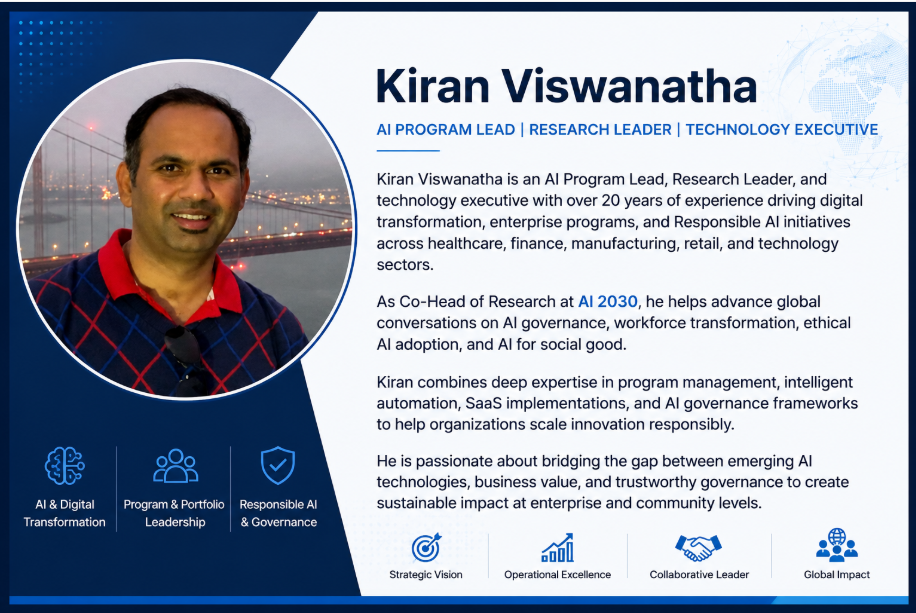
By Kiran Viswanatha
LinkedIn: https://www.linkedin.com/in/kiran-v-79a09630/