September 04 2026 at 10:09AM
The Reincarnated PMO: Embracing Metempsychosis for Organizational Evolution
From Project Control Tower to Adaptive Value Engine
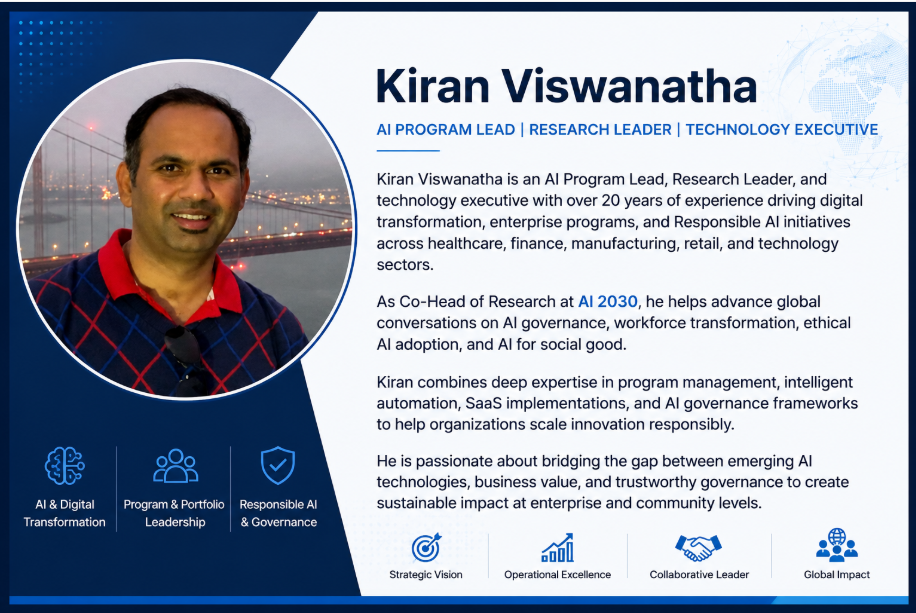
By Kiran Viswanatha
AI Program Leadership | Responsible AI | Research & Governance
“A PMO that refuses to evolve may remain operationally efficient while becoming strategically irrelevant.”
What if the future of the Project Management Office is not about doing PMO better, but about becoming something fundamentally different?
This is where an ancient philosophical concept offers an intriguing metaphor for modern project management:
Metempsychosis
Metempsychosis refers to the transmigration or transformation of the soul from one form into another.
In organizational terms, we can borrow the concept—not literally, but metaphorically—to describe how a PMO can reincarnate into new forms as the organization, technology, strategy, and ways of working evolve.
The PMO of yesterday was often associated with:
governance → standards → reporting → controls → compliance.
The PMO of tomorrow may increasingly become:
strategy → value → intelligence → adaptability → transformation.
The question for project managers and PMO leaders is therefore:
Is your PMO managing projects—or continuously reinventing how the organization creates value?
Did You Know?
The PMO has already gone through several "lives."
It has evolved from administrative support functions into increasingly strategic capabilities.
A simplified evolution looks like this:
PMO 1.0
Administrative PMO
↓
PMO 2.0
Project Control PMO
↓
PMO 3.0
Enterprise / Portfolio PMO
↓
PMO 4.0
Strategic Value PMO
↓
PMO 5.0
Digital / AI-Augmented PMO
↓
PMO 6.0
Adaptive Autonomous Value Office?
The names will differ across organizations.
The underlying pattern is what matters:
The PMO changes when the organization's definition of value changes.
- The Traditional PMO: The Guardian of Delivery
For many organizations, the PMO was created to solve a very practical problem:
"We have too many projects and not enough consistency."
The PMO introduced:
- project standards;
- templates;
- reporting;
- governance;
- schedules;
- risk registers;
- resource management;
- portfolio visibility;
- stage gates.
This created enormous value.
The PMO became the organization's control tower.
But there was an unintended consequence.
Some PMOs gradually became associated with:
"Are you following the process?"
rather than:
"Are we delivering the right outcomes?"
That distinction matters.
- When Governance Becomes the Goal
Imagine a project manager reporting:
"We are green."
The project is:
- on schedule;
- within budget;
- meeting milestones;
- passing governance gates.
Everything looks healthy.
But the customer adoption rate is only 20%.
The project is technically successful.
The investment is not.
This creates one of the fundamental challenges for modern PMOs:
Delivery efficiency is not the same as value realization.
A mature PMO therefore needs to ask more than:
- Are milestones being met?
- Is the budget under control?
- Are risks documented?
It also needs to ask:
- Is the business outcome being achieved?
- Are users adopting the solution?
- Has the expected benefit materialized?
- Should we continue investing?
- Has the strategic environment changed?
- The First Reincarnation: From Project Office to Portfolio Office
The next evolution occurred when organizations realized that managing individual projects wasn't enough.
A company could have:
20 successful projects
and still have
a failed strategy.
Why?
Because projects can individually succeed while collectively competing for:
- money;
- talent;
- technology;
- leadership attention;
- organizational capacity.
The PMO therefore began looking across the portfolio.
Its question evolved from:
"Are projects being delivered correctly?"
to:
"Are we investing in the right projects?"
That was a major transformation.
- The Second Reincarnation: The Strategic PMO
As organizations became more transformation-driven, PMOs increasingly became strategic partners.
The Strategic PMO asks:
Strategy
Does this initiative support organizational priorities?
Investment
Are resources being allocated to the highest-value opportunities?
Capacity
Can the organization absorb the transformation?
Benefits
Are investments producing measurable outcomes?
Change
Can people actually adopt what we're delivering?
The PMO becomes less of a project policeman and more of a strategy execution partner.
- The AI Era Is Creating Another Reincarnation
Now another transformation is underway.
Artificial intelligence is changing:
- project planning;
- forecasting;
- risk analysis;
- documentation;
- resource management;
- stakeholder communication;
- requirements analysis;
- decision support;
- portfolio analytics.
AI can increasingly help PMOs identify patterns that humans may miss.
For example:
Traditional PMO
"Project X has a schedule variance of 12%."
AI-augmented PMO
"Based on current dependency patterns, vendor performance, resource constraints and historical delivery behavior, Project X has an elevated probability of missing the next milestone."
The PMO moves from:
reporting what happened
toward:
anticipating what may happen.
- From Reporting Factory to Intelligence Engine
This may be one of the most important transitions for PMOs.
A traditional PMO spends significant time producing:
- status reports;
- dashboards;
- presentations;
- meeting minutes;
- RAID updates.
An AI-augmented PMO can automate much of this administrative workload.
That creates an opportunity.
What should PMO professionals do with the time they recover?
Not create more reports.
They should spend more time on:
- strategic conversations;
- risk intervention;
- benefits realization;
- scenario planning;
- stakeholder alignment;
- organizational change;
- decision support.
AI should reduce PMO administration so humans can increase PMO judgment.
- The Reincarnated PMO
The future PMO may operate across several dimensions simultaneously.
|
Traditional PMO |
Reincarnated PMO |
|
Project-centric |
Outcome-centric |
|
Reporting |
Decision intelligence |
|
Compliance |
Responsible governance |
|
Historical data |
Predictive insights |
|
Annual planning |
Continuous planning |
|
Static roadmap |
Adaptive roadmap |
|
Resource allocation |
Dynamic capacity optimization |
|
Risk register |
Predictive risk intelligence |
|
Project success |
Benefits realization |
|
Process enforcement |
Value enablement |
|
Human-only analysis |
Human + AI intelligence |
This doesn't mean traditional PMO disciplines disappear.
They become foundational capabilities rather than the final destination.
- The PMO as a Living Organizational Capability
This is where the concept of metempsychosis becomes particularly useful.
A PMO should not be viewed as a permanent organizational structure with a fixed purpose.
It should be viewed as a living capability.
When the organization's needs change, the PMO changes.
For example:
Organization A
Needs delivery discipline.
PMO → Project Control Office
Organization B
Needs portfolio optimization.
PMO → Portfolio Management Office
Organization C
Needs enterprise transformation.
PMO → Transformation Office
Organization D
Needs digital and AI transformation.
PMO → AI / Digital Transformation Office
Organization E
Needs continuous value optimization.
PMO → Value Management Office
The organizational name is less important than the capability.
- Real-World Example: Digital Transformation
Consider a company implementing a major ERP transformation.
Initially, the PMO may focus on:
- implementation schedule;
- integrations;
- data migration;
- testing;
- training;
- cutover.
But after go-live, the real questions emerge:
- Are employees using the system?
- Did process cycle time improve?
- Did data quality improve?
- Did operating costs decrease?
- Are customers experiencing better service?
The PMO's role therefore needs to continue beyond deployment.
Project completion ≠ transformation success.
The reincarnated PMO follows the investment through the value lifecycle.
- Real-World Example: AI Transformation
Now imagine an organization launching 50 AI initiatives.
A traditional portfolio report might say:
42 projects are on track.
But the strategic PMO should ask:
- How many are actually delivering measurable value?
- How many are being adopted?
- Which models create unacceptable risk?
- Where are multiple teams building the same capability?
- Which AI investments should be stopped?
- Where is AI creating new operational risk?
- What workforce changes are required?
The PMO becomes the organization's AI investment and governance nervous system.
- Responsible AI Changes the PMO Conversation
AI introduces something traditional project governance wasn't always designed to handle:
Algorithmic decision-making.
A modern AI PMO needs to consider:
- data governance;
- privacy;
- security;
- bias;
- explainability;
- model risk;
- human oversight;
- AI vendor risk;
- regulatory requirements;
- agentic autonomy.
A project can be:
on time + on budget + technically successful
and still be an irresponsible AI implementation.
Therefore:
Responsible AI governance must become part of AI program governance—not a separate activity performed at the end.
- The Rise of the AI PMO
Imagine an AI-augmented PMO with an intelligent layer.
The important point is the bottom layer.
Human judgment remains central.
AI can augment PMO intelligence.
It should not automatically become the PMO's decision-maker.
- The New PMO Skills
The reincarnated PMO requires a different skill profile.
Project professionals will increasingly benefit from understanding:
Traditional skills
- project management;
- portfolio management;
- risk;
- stakeholder management;
- financial management.
Emerging skills
- AI literacy;
- data literacy;
- prompt/context engineering;
- AI governance;
- Responsible AI;
- scenario planning;
- change management;
- systems thinking;
- benefits realization.
The future PMO leader doesn't need to become a machine-learning engineer.
But they need to understand enough AI to ask the right questions.
- The PMO's New Question Set
Instead of asking only:
"What is the project status?"
Ask:
Strategic
What outcome are we trying to create?
Financial
Is the expected value still greater than the investment?
Predictive
What is likely to happen next?
Organizational
Can the organization absorb the change?
Human
Are employees and customers actually benefiting?
Responsible AI
Should AI be making this recommendation or decision?
Governance
Who is accountable if the system is wrong?
These questions transform the PMO conversation.
- The Reincarnation Cycle
Organizations should expect PMO evolution to be continuous.
This is the organizational version of metempsychosis.
The PMO doesn't disappear.
Its purpose evolves.
- What Project Managers Can Do Today
You don't need to wait for your organization to announce a "PMO 5.0."
Start with five actions.
- Move from activity to outcomes
Don't just report:
"We completed 80% of the backlog."
Report:
"The delivered capability reduced customer processing time by 22%."
- Automate PMO administration
Use AI responsibly for:
- meeting summaries;
- status drafting;
- risk identification;
- action tracking;
- dependency analysis;
- report preparation.
Then redirect human effort toward judgment and leadership.
- Build AI governance into your project
Don't wait until deployment.
Include:
- data ownership;
- privacy;
- AI risk;
- human oversight;
- model monitoring;
- security;
- vendor risk.
- Create a benefits dashboard
Track:
Investment → Delivery → Adoption → Outcome → Value
Not merely:
Budget → Schedule → Scope.
- Become a transformation leader
The most valuable PMO professionals will increasingly be those who can connect:
strategy + technology + people + governance + value.
- A Simple "Reincarnation Test" for Your PMO
Ask your PMO these ten questions:
- Are we measuring projects or outcomes?
- Do we know which initiatives create the most value?
- Can we predict major project risks?
- Are we using AI responsibly to augment PMO work?
- Do we understand our organization's transformation capacity?
- Are benefits tracked after project closure?
- Can we rapidly reprioritize the portfolio?
- Are responsible AI considerations embedded into AI programs?
- Are we reducing administrative burden for project managers?
- If our organization changed dramatically tomorrow, could our PMO change with it?
If the answer to #10 is yes, you may already have a highly adaptive PMO.
If the answer is no, the next reincarnation may already be overdue.
The Future: PMO as a Value Operating System
Perhaps the most interesting future isn't a PMO with more dashboards.
It is a PMO that becomes an organization's value operating system.
It connects:
Strategy
↓
Investment
↓
Portfolio
↓
Projects
↓
People
↓
Technology
↓
AI
↓
Risk & Governance
↓
Benefits
↓
Organizational Learning
And then feeds that learning back into strategy.
The PMO becomes a closed-loop organizational learning system.
Final Thought
Metempsychosis traditionally describes the movement from one form to another.
For today's PMO, the metaphor is powerful:
The PMO doesn't need to preserve its original form to preserve its purpose.
Its deeper purpose is to help organizations turn strategy into sustainable value.
That may require the PMO to move:
from control → enablement
from reporting → intelligence
from projects → outcomes
from static governance → adaptive governance
from human-only processes → human + AI collaboration
from delivery management → organizational evolution
The question for every PMO leader is therefore not:
"How do we protect the PMO?"
It is:
"What does the organization need the PMO to become next?"
Because the most successful PMO may not be the one that survives unchanged.
It may be the one that continuously reincarnates.
PMO Evolution at a Glance
PMO 1.0: Are we following the process?
↓
PMO 2.0: Are we delivering the project?
↓
PMO 3.0: Are we investing in the right portfolio?
↓
PMO 4.0: Are we executing strategy?
↓
PMO 5.0: Are we creating measurable value?
↓
AI-Augmented PMO: Can we anticipate, adapt, and govern intelligently?
↓
Reincarnated PMO:
Can the organization continuously evolve—and can we help it get there?
— Kiran Viswanatha