May 02 2026 at 09:00AM
Turning Principles into Execution for AI Leadership
Many organizations talk about Responsible AI—but very few have a clear, actionable governance plan in place.
AI governance is not just about policies or compliance—it’s about operationalizing trust, accountability, and control at scale.
For AI leadership teams and project managers, the real question is:
👉 How do we move from intention to execution?
Why AI Governance Needs an Action Plan
Without a structured plan, AI initiatives often face:
- inconsistent data practices
- unmanaged risks (bias, privacy, security)
- lack of accountability
- delayed or failed deployments
With a strong governance action plan, organizations gain:
- trustworthy AI systems
- regulatory compliance
- scalable implementation
- faster decision-making with confidence
👉 Governance is not a blocker—it’s an enabler of sustainable AI growth.
The 5-Step AI Governance Action Plan
🔹 Step 1: Define Governance Vision & Principles
Start with clarity:
- What does responsible AI mean for your organization?
- What risks are you willing (or not willing) to take?
- How does AI align with business strategy?
Real-World Insight
Leading organizations define AI principles such as fairness, transparency, and accountability before building models.
👉 Outcome: A clear AI governance charter
🔹 Step 2: Establish Roles, Ownership & Accountability
Governance fails without ownership.
Define:
- AI governance council / steering committee
- Data owners and model owners
- Risk and compliance stakeholders
Real-World Insight
Organizations that assign model accountability (who owns the outcome of AI decisions) reduce ambiguity and risk.
👉 Outcome: Clear RACI model for AI governance
🔹 Step 3: Build Policies & Control Frameworks
Translate principles into execution:
- Data governance (quality, privacy, access)
- Model governance (validation, explainability)
- Risk management (bias, drift, misuse)
Real-World Insight
Financial institutions implement model validation frameworks before deploying AI into production.
👉 Outcome: Standardized governance policies and controls
🔹 Step 4: Integrate Governance into the AI Lifecycle
Governance must be embedded—not added later.
Apply controls across:
- Data ingestion
- Model development
- Deployment
- Monitoring
Real-World Insight
Organizations using MLOps pipelines integrate governance checkpoints (e.g., bias testing before deployment).
👉 Outcome: End-to-end governed AI lifecycle
🔹 Step 5: Monitor, Audit & Continuously Improve
AI is dynamic—governance must be too.
- Track model performance and drift
- Audit decisions and outcomes
- Update policies as risks evolve
Real-World Insight
Companies continuously monitor AI systems in production to detect anomalies and maintain compliance.
👉 Outcome: Adaptive governance framework
The Role of Project Managers in AI Governance
Project managers are critical to making governance real:
- ensuring governance checkpoints are included in project plans
- coordinating across data, AI, and compliance teams
- tracking risks and mitigation actions
- driving accountability and execution
👉 They bridge the gap between strategy and implementation.
Common Pitfalls to Avoid
❌ Treating governance as a one-time setup
❌ Delaying governance until after deployment
❌ Lack of cross-functional alignment
❌ Overcomplicating policies without execution clarity
👉 The key is balance: structured, but practical
How This Helps Leadership Teams
A strong AI governance action plan enables:
- confidence in AI decisions
- faster approvals and scaling
- reduced regulatory and reputational risk
- alignment across business and technology teams
A Practical Starting Point (What You Can Do This Week)
- Identify your top 3 AI risks
- Define ownership for each AI system
- Document minimum governance controls
- Schedule a cross-functional alignment session
- Start building a governance backlog
Final Thought
AI governance is not about control for the sake of control.
It is about creating the foundation for trusted, scalable, and responsible AI innovation.
🎯 Leadership Takeaway
AI success doesn’t come from building smarter models alone—it comes from governing them with clarity, accountability, and continuous discipline.
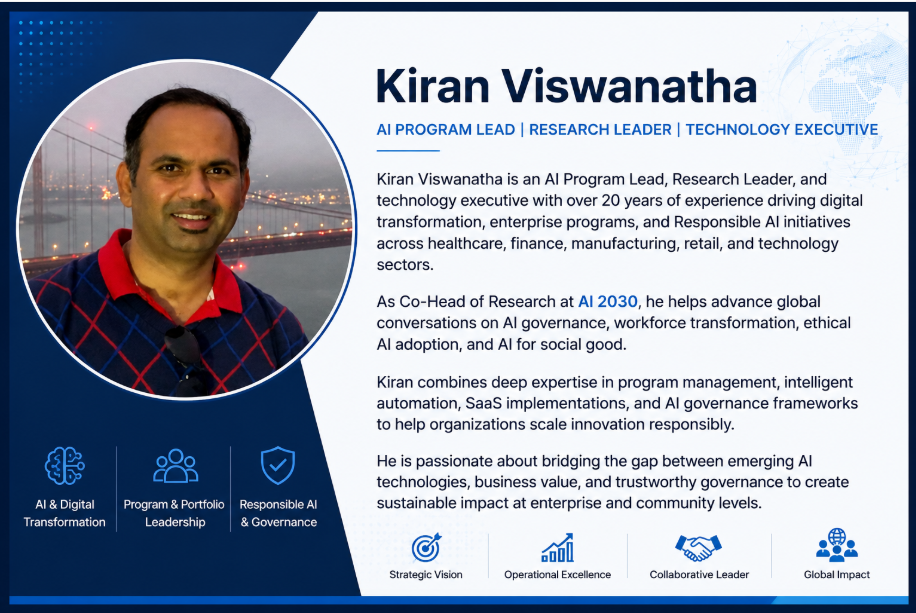
By Kiran Viswanatha
LinkedIn: https://www.linkedin.com/in/kiran-v-79a09630/