May 18 2026 at 12:00PM
Why Organizations Need “Motherly Care” in AI Governance for Implementations
Successful AI governance is not just about control—it’s about guidance, protection, nurturing, and long-term growth.
📊 The “Motherly Care” Governance Model
Protect → Guide → Monitor → Correct → Improve → Scale Responsibly
🌱 Introduction: AI Needs More Than Rules
Did you know that many AI failures do not happen because organizations lacked technology—but because they lacked the right care, oversight, and nurturing approach during implementation?
As enterprises race to deploy AI solutions:
- Governance often becomes reactive
- Teams focus heavily on speed
- Human impact gets overlooked
- Long-term sustainability is ignored
This is why organizations increasingly need what can be described as “Motherly Care” in AI Governance.”
Not in the emotional sense alone—but as a leadership philosophy centered on:
- Protection
- Guidance
- Accountability
- Continuous learning
- Responsible growth
AI systems, like growing ecosystems, require thoughtful care—not just technical supervision.
🤱 What Does “Motherly Care” Mean in AI Governance?
Motherly care in AI governance represents:
- Preventive thinking instead of reactive firefighting
- Responsible nurturing instead of unchecked acceleration
- Long-term trust instead of short-term experimentation
It means leaders must:
- Protect users from harm
- Guide AI systems responsibly
- Continuously monitor and improve outcomes
- Balance innovation with empathy and accountability
🛡️ Why Organizations Need This Mindset
AI implementations today influence:
- Customers
- Employees
- Patients
- Financial decisions
- Business operations
Unlike traditional software:
AI systems learn, evolve, and scale rapidly.
That means:
- Small governance gaps become amplified
- Poor oversight creates enterprise-wide risks
- Lack of human-centered thinking reduces trust
👉 Organizations need governance that behaves less like a policing function and more like a responsible caretaker.
🌍 The Five Dimensions of “Motherly Care” in AI Governance
🔷 1. Protection Before Harm
A mother protects before danger escalates.
Similarly, AI governance must:
- Identify risks early
- Prevent harmful outcomes
- Embed safeguards proactively
Examples:
- Bias testing before deployment
- Human review for high-risk decisions
- Access controls and privacy protection
👉 Leadership Insight:
Responsible AI begins with prevention, not damage control.
🔶 2. Continuous Guidance & Learning
AI systems require constant monitoring and correction.
Organizations must:
- Continuously evaluate model behavior
- Adapt governance policies
- Learn from incidents and feedback
Example:
AI copilots improving through monitored human feedback loops.
👉 AI governance is not a one-time approval—it is an ongoing relationship.
🔷 3. Building Trust Through Transparency
Strong governance creates psychological safety.
Teams and users trust AI more when:
- Decisions are explainable
- Accountability is visible
- Oversight mechanisms are clear
Example:
Healthcare AI systems that provide explainable recommendations improve clinician confidence.
🔶 4. Encouraging Responsible Growth
Good governance should not suffocate innovation.
Instead, it should:
- Enable safe experimentation
- Provide structured guardrails
- Create scalable governance frameworks
👉 Like good parenting:
The goal is not restriction—it is responsible empowerment.
🔷 5. Human-Centered Decision Making
Motherly care emphasizes empathy and impact on people.
Organizations must ask:
- How will AI affect employees?
- Does this improve human outcomes?
- Are vulnerable groups protected?
Example:
AI hiring systems designed with fairness reviews and diverse validation datasets.
🚀 Real-World Governance Lessons
🔹 Financial Services
Organizations that added:
- Human approval workflows
- Explainability requirements
- Continuous monitoring
Saw:
- Reduced compliance risk
- Greater customer trust
- Improved regulator confidence
🔹 Healthcare
Hospitals implementing AI diagnostics with:
- Clinician oversight
- Ethical governance committees
- Transparent validation processes
Achieved:
- Safer deployments
- Higher adoption rates
- Better patient confidence
🔹 Enterprise AI Assistants
Companies that introduced:
- Guardrails
- Usage monitoring
- Role-based access
Prevented:
- Data leakage
- Misinformation spread
- Productivity disruption
👨💼 The Critical Role of Project Managers
Project managers are central to bringing “motherly care” into AI implementations.
They help ensure:
- Governance is embedded early
- Stakeholders remain aligned
- Human impacts are considered
- Risks are tracked continuously
✔ PM Responsibilities Include:
- Governance checkpoints in delivery plans
- Coordinating AI, legal, and business teams
- Monitoring adoption and trust signals
- Driving continuous improvement cycles
👉 Project managers become stewards of responsible execution—not just delivery coordinators.
⚠️ What Happens Without This Approach?
Without nurturing governance:
❌ AI systems scale faster than oversight
❌ Teams optimize only for speed
❌ Bias and operational risks go unnoticed
❌ Trust erodes internally and externally
❌ Innovation becomes unsustainable
📊 The “Motherly Care” Governance Model
Protect → Guide → Monitor → Correct → Improve → Scale Responsibly
🧠 Leadership Shift Required
From asking:
“How fast can we deploy AI?”
To asking:
“How responsibly can we scale AI while protecting people, trust, and long-term value?”
🌟 Key Takeaways for AI Leaders
✅ Governance must be proactive, not reactive
✅ Human-centered oversight is essential
✅ Continuous monitoring builds trust
✅ Responsible scaling creates sustainable innovation
✅ AI needs nurturing ecosystems—not just policies
🧭 Closing Thought
In the AI era, organizations cannot govern AI with technology alone.
They must govern with:
- Wisdom
- Empathy
- Accountability
- Continuous care
The most successful AI organizations will not be those that move the fastest—
but those that scale AI responsibly, thoughtfully, and sustainably.
Because ultimately:
AI implementations don’t just need intelligence.
They need guidance, protection, and the kind of governance that cares about long-term human impact.
✨ AI Leadership Reflection
“Strong AI governance is not about controlling innovation—it’s about nurturing it responsibly so it can thrive safely at scale.”
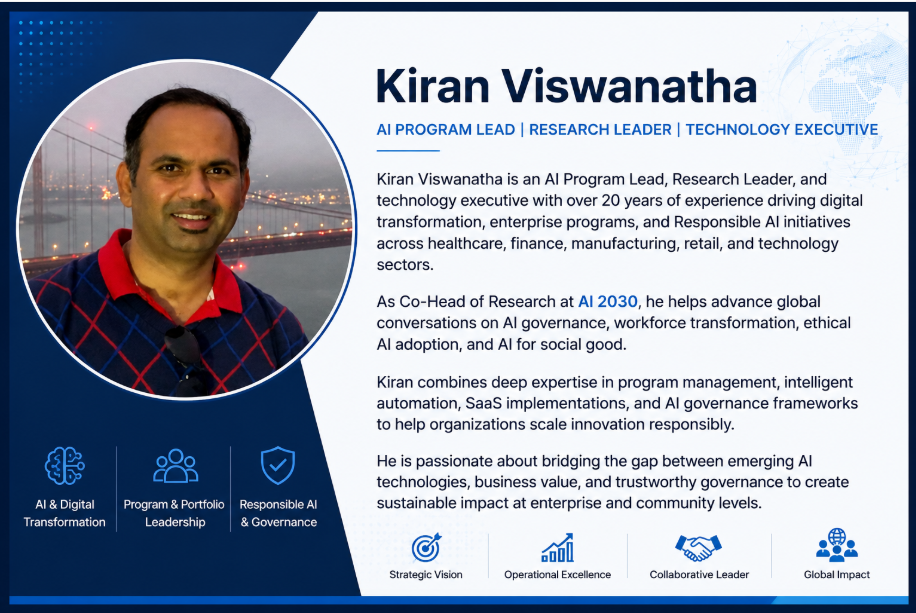
By Kiran Viswanatha
LinkedIn: https://www.linkedin.com/in/kiran-v-79a09630/